Category: The Landlord’s Perspective

  • As Cities Grow, Property Management More Important

    As Cities Grow, Property Management More Important

    – Guest Blogger, Tommy Hiltz, Colliers International

    When I tell people my company does property management, I get plenty of pleasant, vacant smiles. The truth is, not many people know what we do, how we do it, or even why we are needed. Many people have violent flashbacks to the front office workers at their first apartments, who refused to acknowledge broken appliances or leaky faucets. In their mind, we represent that worker, albeit a bit nicer and hopefully more responsive. Our purpose remains associated with negative occurrences and retroactive inadequacies. Yet property management can justify itself in tangible ways not only to owners, but to tenants, employees, and customers.

    While the scope can be as wide as the “management” implies, the property manager faces three main objectives:

    1.    Handle unforeseen events
    2.    Assist with future planning
    3.    Oversee expansion

    1.     Handle unforeseen events – A roof of a multi-tenant office building leaking during a thunderstorm is a bona-fide nightmare for all parties involved.  Tenants might try to call the owner, who could be an institutional investor which, due to its remote location, is functionally incapable of handling the emergency.  The tenant might then search the internet, praying that whomever they call does quality work as rain water continues to pool on computers, carpeting, machinery, and equipment.  Property owners engage property managers to avoid this scenario.

    On any given day, we are called to deal with cracked windows, burst pipes, broken air conditioning units, and countless other problems.  Property managers can offer a painless resolution to harrowing situations by being prompt and flexible, bringing detailed experience and a robust rolodex of professional service providers.

    2.    Assist with future planning- A critical aspect of property management is preserving the value of the building for the future.

    Because we spend so much time at the properties, we have an intimate knowledge of current conditions that enables us to plan repairs and property improvements and budget with accuracy the properties performance.  While some of these expenses, such as Maintenance and Repairs, require us to make educated estimates that account for risings costs and different circumstances, others can be more intricate.

    Our planning often involves large capital outlays such as renovations, expansions, or freestanding construction.  If an owner has an opportunity to increase the return on investment (ROI), internal rate of return (IRR) or resale value, the property manager is in a great position to point out that opportunity and then oversee implementation of the plan

    3.    Oversee expansion- Many owners feel unequipped to evaluate the financial merits of a possible project and many lack the time or knowledge to oversee the physical implementation of said project.  The property manager can coordinate with the owner, contractors, subcontractors, and other involved parties to ensure that projects run not only on-time, but at or under budget.  At Colliers, we routinely oversee significant projects with the goals of adding value and maximizing tenant satisfaction.

  • Guns at the office?

    Guns at the office?

    John Pickering, Partner at Balch & Bingham

    Last month (September 2016), the FBI ran just under two million background checks for people wanting to purchase guns in the United States. September also marked the 17th consecutive monthly record for U.S. gun purchases. Depending on your political views, these numbers may alarm or encourage you, but politics aside, consider this – some of these guns will probably be showing up in your office, particularly in a generally gun-friendly state like Alabama.

    What’s a responsible employer to do? Ban all guns to assure the safety of your employees? Permit law-abiding employees to exercise their constitutional rights to protect themselves and their co-workers on the job? Alabama law actually gives employers the liberty to set their own policies in this context, for the most part. In Alabama, employers are free, but not required, to prohibit employees from bringing guns to work or carrying guns while on duty, even if the employee has a valid concealed carry permit.

    However, the employer’s freedom ends where the employee’s begins – in the parking deck or lot. Employers may not ban the possession of a lawfully possessed gun or ammunition in the employee’s privately owned vehicle while that vehicle is in the parking area if the employee has a valid concealed carry permit. There are also special rules for long guns used for hunting, regardless of permit status, though they have many more qualifications. The employee with a long gun in the car is protected if the employee has a valid Alabama hunting license, the long gun is unloaded, the calendar says it’s hunting season, the employee has not been convicted of a crime of violence, a child sex offense, or domestic violence, and is not the subject of a domestic violence order, the employee doesn’t meet certain thresholds for mental illness and has no documented prior workplace incidents involving threats of violence or which resulted in injury, the vehicle isn’t violating any rules of the parking facility, and the ammunition is hidden from view or, if the vehicle is unattended, is locked safely away in a separate compartment or container within or affixed to the vehicle.

    Concerned that an employee presents a risk of harm to himself or others? You may ask whether the employee has a gun, even a gun in his vehicle, and you may ask questions to verify that the employee meets the requirements stated above. But you cannot take adverse action against the employee solely for gun possession if the employee meets those requirements.

    If an employer violates these standards, the employee can recover lost wages, benefits and compensation resulting from the violation. The statute balances the employer’s interest by protecting the employer (and property owner) with immunity from any claim against the employer based on an employee’s possession of a firearm on the employer’s property, possibly whether permitted or not. Employers also have no duty to inspect private vehicles or parking facilities.

    Consider your gun policies carefully; your employees will be watching!

  • The Elusive As-Built CAD File

    The Elusive As-Built CAD File

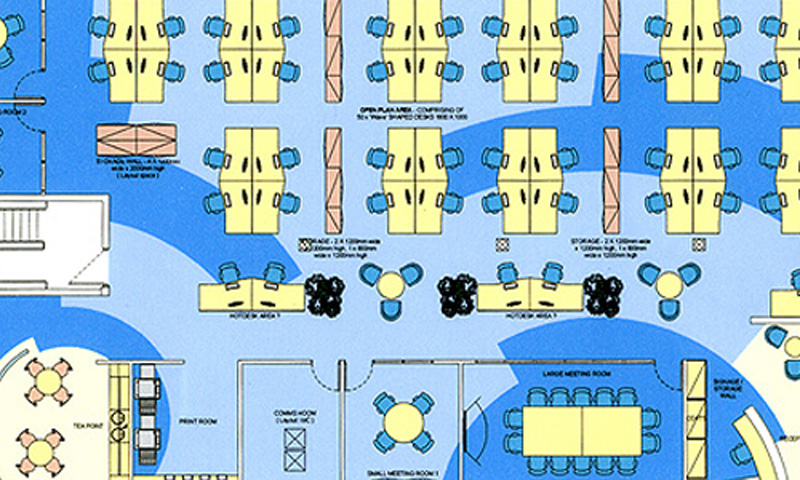
    As a broker, tracking down as-built CAD files for space under consideration by my clients is one of my least favorite activities.  The problem arises when a client is considering second generation space in a building and wants to do a test fit or space plan.  It is not my least favorite activity because the task of requesting CADs is beneath me, rather, it seems that landlords never have them. Landlords and tenants share equally in the blame for this problem.
    The simple solution is, in the case of a build-out managed by the tenant, for the landlord to require in its leases that the tenant architect turn over final as-built CADs to the landlord upon completion of the tenant’s space.  If the landlord is responsible for the build-out, the landlord should stipulate in its contract with the architect designing the space that the architect provide as-built CADs prior to submitting their final invoice to the landlord.

    Plans change during construction as a result of “value-engineering” or “tweaking of the design”.  If as-built CADs are required AFTER construction completion, the landlord can ensure that it always has full CADs for its building and will eliminate the cost and hassle of producing them next time it tries to lease the space.