Author: Anita Turner

  • Does Remote Work Really Work?

    Does Remote Work Really Work?

    Living in a southeastern city without a well-developed mass transit option, I bear witness to increasing commute times and the pressure they exert on employee and employer alike.  In fact, I recently spoke to a law firm principal frustrated by the dilemma of how to reduce the time her employees spend in the car without compromising culture, mentoring and teamwork.  She asked me what other employers are doing to solve the commute problem, so I asked them.

    It turns out there is a lot of information out there about who is allowing “limited” telecommuting – i.e. two days per month — and very little information about how to make it work.  So, I dug a little deeper and reached out to some veterans of the tech industry who have implemented “distributed workforce” models.  In these models, employees are geographically spread across the country (or even globe) and almost exclusively telecommute.

    I also read the book “Remote: Office Not Required” by the founders of Basecamp, a project management and communication software often used by these companies.

    Finally, I reflected on my first hand experience: I telecommuted across many states for six years of my career.

    Here’s what I learned.

    Why adopt the remote or “distributed workforce” model?

    • Access to talent. When employers can hire employees anywhere in the world, the labor market increases exponentially.  A specialization that seems difficult to find in a small market is more readily found when proximity is removed from the equation.
    • Flexible schedules and reduced commute times. If an employer can allow their employees to work flexible hours and eliminate commute time, it becomes a more attractive employer and may reduce the likelihood of employee turnover.
    • Reduced overhead resulting from elimination of office space overhead. Less office space equals significant savings to the employer – even after subtracting the costs of equipping remote employees — especially if the employer is headquartered in a high rent office market.
    • Employees save money too. Per flexjobs.com, the average person can save at least $4,000 per year by working remotely.  Most of this savings comes from gas, car maintenance, dry cleaning and wardrobe costs.

    Who gets to work remotely?

    Determining who can and should work remotely depends significantly on whether you are starting a new business where any and all employees might be remote, or trying to convert some positions in an existing business to a remote model.

    In my case, I was marrying someone in the military and the US Air Force was going to determine where I lived.  I had been at JLL for three years and my open-minded boss, Frank Mann, agreed to let me try working remotely and see what happened.

    Shegun Otulana, on the other hand, started his company, Theranest, with a remote model.  Theranest provides practice management software for the mental health industry, and per Otulana, “We needed to scale company size without raising a lot of money… I am a developer so I felt I could do the work and successfully manage anyone doing it. It naturally extended to non-programming roles as well and worked out great for us.”

    In other instances — law firms for example – there is a long tradition of in-office work.  Culture must shift to introduce a remote option.  As you can imagine, shifting the culture of a historically very traditional occupation is a challenge, but it’s possible.  One law firm introduced the remote working option by allowing associates who had finished their second year to work remotely.  Presumably the firm believes that third years were sufficiently trained and ready to be more independent.  Likely they had also proven their work ethic.

    Other firms have introduced remote work on a limited basis, for instance, allowing employees to work remotely one day per week.

    If you are hiring someone straight into a remote position, how do you on-board them effectively?

    Most of the sources I consulted with agree that ideally, on-boarding should be done in person.  When Otulana founded Theranest, however, on-boarding was done remotely.  While this helped manage costs, Theranest shifted its approach.  They now bring all new hires to Birmingham for the first several days of employment.  “They get to meet people in person and get immersed all day for a couple days.”  Why? Employees need to know not just who they are working for, but who they are working with.  They need to be able to put a face with a name.

    Fleetio, a fleet management software company, also brings remote employees to its Birmingham headquarters for their first week.  After that, they have a very structured on-boarding process they go through via Asana.

    How do you set up a remote employee?

    In order to succeed remotely, employees need to have the tools to communicate with their teams, the hardware on which to work, and appropriate connectivity.

    Otulana says his company uses web phones and provides all employees with computers.  Theranest used to reimburse for co-working space but now opt instead to give an allowance to setup a home office.  Similarly, Tony Summerville, founder of Fleetio, says his company sends a laptop, monitor, an other hardware to each new employee’s home.  On their one year anniversary, Fleetio gives employees a budget to buy more home office furniture like a desk and a nice chair.

    When I went to remote working, it was during the age of dial-up connectivity.  JLL set me up with a separate phone line (so old school) and computer and I was ready to work.

    How do you ensure effective and consistent communication with and between remote employees?

    Most tech companies rely heavily on project management and communications software like Slack and Zoom.  But it’s not as simple as just selecting a software tool; you have to effectively use the tool.

    Phone pods
    Theranest’s phone pods

    Theranest established a culture early on where everyone uses Zoom from their desks — even when some meeting attendees are in the office together and others are remote.  This ensures that remote and in-office employees are on equal footing. Per Otulana, “this way, the remote people don’t get the ‘us’ and ‘them’ feeling. Everyone is connecting and communicating individually through Zoom.  [And] When needed, we bring people down [to Birmingham] to communicate face-to-face.”

    Just a typical Fleetio collaboration session.

    Cadence Bank SVP and Director of Facilities, Jennifer Bratton, manages a team scattered across the bank’s southeastern footprint.  She uses to Zoom to have face-to-face meetings with her team any time and finds it makes managing a distributed team feasible.  Also Bratton believes the eye contact enabled by Zoom also encourages employees to be better engaged than while on audio-only conference calls.

    In my experience, neither my clients nor my co-workers seemed to care that I wasn’t in the home office so long as I answered my emails or  returned phone calls promptly.

    How do you indoctrinate new hires into your company culture?

    The authors of Remote state “You certainly don’t need everyone physically together to create a strong culture.  The best cultures derive from actions people actually take, not the ones they write about in a mission statement.  [Newcomers] see how decisions are made, the care that’s taken, the way problems are fixed and so forth.”

    Summerville gives new employees a company overview during their first week in Birmingham, focusing more on Fleetio’s history, beliefs, values and other cultural elements.  Theranest works similarly, however, Otulana states “culture is what we reward so it happens over time.”

    Does remote working reduce or increase employee turnover?

    In many companies, especially those that allow in-person employees to transition to remote workers, the model reduces turnover.  In part, this is because employees that would otherwise have to leave a company due to a family move are able to continue working from another location (my situation).  Similarly, eliminating commutes and giving employees back that time creates happier employees who are more likely to remain with the company.

    When remote employees are treated like second class citizens and not included in meetings, et cetera, turnover can be higher.  Many remote employers combat this by creating virtual water coolers.  This is often done via a permanent chat room “where everyone hangs out all day to shoot the breeze, post funny pictures, and generally goof around.”[i]  Github created a forum called #toasts where employees can post major accomplishments and colleagues from around the world post selfies toasting them.

    There is virtually no difference in turnover rates between in-office and remote employees at Theranest.  Similarly, Fleetio notices only a slightly higher turnover in remote employees, and their overall retention rate is great.

    Beyond cost reduction, can remote workers contribute to greater productivity?

    Absolutely.  When properly set up, remote workers are better able to focus and less distracted by workplace hubbub- unless they choose to be.  And for the billable hour professions like law, just think how many more hours your billers can bill when they aren’t stuck in cars, parking decks and elevators!

    What do you think?  Have you worked remotely?  Would you allow your employees to do so? I would love to hear your thoughts!


    [i] Remote.  p. 100

  • What Lawyers Can Learn from Brad Anderson

    What Lawyers Can Learn from Brad Anderson

    The Set Up

    Earlier this year, I represented a tenant negotiating a smallish lease in a suburban Birmingham building.  The landlord’s brokers and I thoroughly negotiated a letter of intent which was to be the basis for the draft lease.

    Less than a week after we agreed on terms, we received a draft lease from the landlord’s attorney.  For those readers unfamiliar with the office leasing process, this is bordering on record-breaking speed.  My client and I were thrilled as speed to occupancy was vital in this deal.

    It Gets Better

    Once I began reviewing the draft document, I was ecstatic – but not because it was so tenant-friendly.  Rather, the lease draft was FAIR.  The attorney who drafted it clearly was intent on not wasting his client’s time and money by inserting boilerplate landlord-friendly language that is sure to be negotiated out by the tenant’s attorney.

    This lease contained language that was fair to both sides, protecting the drafter’s landlord client while also endeavoring to give the tenant clarity on its obligations and rights.  A freaking dream.

    I immediately called the landlord’s broker to ask him who the drafting attorney was. It is worth noting that this is a broker I have negotiated with and against for twenty years and my lease negotiation reputation is deservedly “intense.”  I assured the broker that I wanted the name so I could hire this attorney for future legal work on behalf of my clients.

    A Done Deal

    The rest of the negotiation proceeded smoothly despite the fact that it was not the simplest of deals.  And I am positive that when the landlord got his legal bill he was both pleasantly surprised at the size of it and thrilled with the work that had been done.

    The attorney’s name is Brad Anderson and he is with Butler Snow in Birmingham.  One of my client’s will be using him to draft a restaurant lease for a new development.  Pay attention: we are hiring him to draft a landlord lease because despite the fact that he didn’t draft an overly landlord-favorable lease, I saw that he represented his landlord client well.  And, one of my tenant clients will be using him to negotiate leases on behalf of his company going forward.

    The Moral of the Story

    People: Brad Anderson gets it.  Clients want value.  In my industry, they want deal-makers. They don’t want a lawyer who is going to throw the most biased lease out there knowing that, at worst, it jeopardizes the deal and, at best, the other side is going to spend hours reviewing and negotiating away that unnecessary bias.  This may increase Brad’s billable hours but it isn’t going to increase his client satisfaction.  Clearly, Brad realizes that satisfied clients are repeat clients.

    Brad drafted a fair and reasonable lease.  He handled the negotiations fairly and reasonably.  And the result is a happy client, a landlord and tenant with a good working relationship, and new business from me and my clients.  Not bad.

    Be like Brad – so good legal buyers can’t ignore you.

  • Five Cool Things from L.A. in April

    Five Cool Things from L.A. in April

    I spent most of my twenties in Los Angeles enjoying some much needed sunshine (and grad school) after a childhood of Minnesota winters.  While Birmingham’s weather is much better than Minnesota’s, I still jumped at the opportunity to go back to sunny LA last month.  And although it was fun, Birmingham is not in jeopardy of losing me.

    Los Angeles, I love and miss you but we aren’t getting back together.

    Western Legal Leaders Council

    The primary purpose of my LA visit was to speak at the inaugural meeting of the Western Legal Leaders Council.  This is a new group of law firm COOs from select firms west of the Mississippi put together by Catapult Growth Partners’ Steve Daitch and Irell & Manella’s Mark Hanson.

    While I am sure I was the least distinguished of the meeting’s speakers, I was immensely grateful for the opportunity to share what I have learned about the law firm C suite and it’s monetary value to law firms.  (You can read my report on the topic here.)

    If you have read my blog for any length of time, you know that any time I travel, I do my best to visit some cool spaces.  So, when I wasn’t attending the conference, I had the pleasure of touring Yahoo’s Silicon Beach campus, Google’s new campus inside the Spruce Goose hangar in Playa Vista, and The Honest Company’s space.

    Yahoo!!!!

    Yahoo, now owned by Verizon, occupies three buildings totaling ~88,000 rsf – each with the same basic footprint.  One building contains workspace and a large cafeteria and fitness center.  One building contains workspace for Ryot Studio, Xbox and Yahoo Sports.  And the last building contains film studios for Yahoo Sports.  In which they were recording.  With a famous athlete.  But wouldn’t let me in.  Sigh.

    Gym at Yahoo!All of Yahoo’s buildings have glass exteriors, are two stories tall and have extremely high and open ceilings.  The exterior spaces are equally airy and light filled.  In fact, there is a beautiful green courtyard between the three buildings with abundant outdoor seating.

    One of my favorite things seen at the Yahoo buildings? The booths they incorporated for small informal meetings.  While I realize booths are all the rage in the modern office buildout, these are unique in that one of the “open” walls is not actually open.  Instead, it is a glass wall and the booth seating goes around that side.  The result is more seating and better audio privacy without compromising transparency and light.

    Another view:

    Did Verizon’s acquisition of Yahoo change anything in the space?  Well, it’s still 100% open plan, but let’s just say the “free snack shelves” are now basically shelves.  Don’t feel too bad for the employees; breakfast and lunch are still complimentary.

    The Honest Company

    Next it was on to The Honest Company.  Its space is as soothing and Zen as you would anticipate given the company’s name and its famous founder.  It boasts tons of light and natural materials – from various woods to wool rugs to plants.

    The Honest Company’s employees each have a dedicated workspace which they are welcome to adorn as they see fit.  The desk areas are very simple and open but (like Gensler’s offices in Washington DC), they seem full of life and energy.  The best analogy I can come up with is it feels like you are working in one of your most hip twenty-something friend’s apartments.

    And if The Honest Company employees need a change of scenery, they can go work in one of the beautiful library-like common spaces or on the rooftop patio.

    Google

    My last visit was to Google and — no disrespect to Yahoo and The Honest Company — my mind was blown.

    As mentioned above, it was built in the former hangar for Howard Hughes’ Spruce Goose.  Because it is a historic building, Google had to build ten feet from the interior face of all exterior walls and ceilings.  As a result, all of the floors “float” in the building.

    There are many nods to the building’s past, including this stunning ceiling installation in the shape of the Spruce Goose.

    In addition, Howard Hughes’ original office at the center of the highest portion of the building was preserved and converted into a conference room.

    The space features amenities including a cafeteria with an in-house chef who gives regular Food Talks to interested employees and competes in competitions with other Google chefs nationally.  There is a dreamy fitness center complete with personal trainers and numerous group exercise classes.  And there is a nap room, meditation room, mother’s room, bike room (where you can borrow a bike or store your own), coffee bar, and massage room.

    No, the massages aren’t free but employees accrue Google Bucks as rewards that can be spent on massages and other things.

    Google did something whimsical and brilliant with the future growth space that has yet to be furnished with desks and employees.  Above the space, on a floating walkway sits a station where Googlers can get paper to build an airplane which they can then use to hit a target on the floor below.

    In another such growth space, Googlers can write comments, suggestions or complaints on a piece of paper and then try to toss that paper into the bins below.  Notice the size of the opening on the complaints bin!

    Other trip highlights?

    SoulCycle

    I have always wondered if SoulCycle would live up to the all the fuss about it.  Since there was one a mile from my Santa Monica hotel, I paid the $20 first-timer’s fee and attended a class.  And? It felt like every other spin class I have taken from a good teacher.  Which is fine except that regulars pay $40 for a 45 minute class.  What in the what?  If this class does not make my tushie look like a tulip afterwards, I am not paying almost $1 per minute to ride a bike at 85% of my max heart rate.  Nope.

    From a real estate perspective, the space reflects planning genius.  The studio itself is packed (some would say crammed) with bikes such that stretching your arms could be considered inappropriate touching by the people on neighboring bikes.  (Note that this coziness did not seem to bother the other attendees.  Some appeared to enjoy the energy it created.)

    Walls in the lobby are lined with lockers and benches, and small but nice locker rooms are tucked behind the reception desk.  The whole space is white with bright yellow splashes which make it feel bigger than it actually is.  Way to maximize space while minimizing real estate costs.

    Experience Value: C-.  Space Design: A+.

    drybar

    I also gave drybar a whirl one morning.  While a $49 blowout sounds indulgent on my part, I am calling it market research.  You see, my company is working on some large mixed-use developments and I can’t believe — given Birmingham’s reputation as the land of the “done” hair — that we have zero drybars here.

    The overall drybar experience is pampering.  The space was incredibly well-designed to be both efficient and purposeful.  There is a mid-sized rectangular front room with a central bar area around which all of the clients sit.  The hairdressers work behind the clients while the clients sit and read, work or stare at their phones.  Behind the front room is a small shampoo room with eight stations efficiently arranged to make the best use of the small space.  Like SoulCycle, A+ for space design and minimizing real estate costs.

    My only reservation about my drybar experience is that I clearly don’t have thick or curly enough hair to justify paying someone else $49 to blow it dry – especially knowing I am going to have to wash it the next morning after the above-described SoulCycle workout.

    I DO think drybar would be an amazing addition to Birmingham’s retail scene and am now actively recruiting the company to the area!

    Social Hour(s)

    Lastly, while in LA, I reconnected with a bunch of law school classmates. One of them, Robin Gerard, is now a CMO for Orange County-based Stradling Yocca.  I could not have had more fun catching up with her.  She single-handedly helped me drag my aforementioned tushie across the finish line of two different LA Marathons “back in the day.”   Our marathon mantra: “Only one person can complain at any one time.”

    Robin had tons of knowledge on all things marketing and business development and gave me great insight prior to my speaking engagement.  Between her and my Western Legal Leaders’ Dinner tablemate, Catapult’s Doug Johnson, I felt like I went back to Birmingham smarter.  What a trip!

  • Building a Company Culture: 23 Books and a Few Podcasts

    Building a Company Culture: 23 Books and a Few Podcasts

    I freaking love to read.  And my two favorite non-fiction subjects are company culture and the legal industry. (Shocker.)

    I thought it would be fun to ask the people I admire running non-profits, companies and law firms here in Birmingham what their favorite books on culture are.  They did not disappoint!

    Some books I have read; others are now on my To Read list on Goodreads; a few are on their way from Amazon to Casa Turner.

    Enjoy!

    Erich Durlacher, President & Strategy Partner, Burr Forman, recommends three books, all of which I have read and loved.  They are Smart Collaboration by Heidi Gardner, Give and Take by Adam Grant, and Start with Why by Simon Sinek.  Clearly Erich and I have similar reading taste, so Erich, please keep the recommendations coming.

    Greg Curran, Chairman, Maynard Cooper & Gale, recommends The Advantage: Why Organizational Health Trumps Everything Else in Business by Patrick Lencioni.  In a review of this book, Publishers Weekly recaps Lencioni’s four steps to organizational health: “build a cohesive leadership team, create clarity, overcommunicate clarity, and reinforce clarity.”  This seems like the perfect approach for a law firm!

    JW Carpenter, Executive Director, Birmingham Education Foundation (& former lawyer) loved Radical Candor: Be a Kickass Boss Without Losing Your Humility by Kim Malone Scott.  JW says “celebratory and constructive feedback is crucial to success but very hard to deliver in an effective, honest, and human way. Radical Candor outlines how you can do that and why it is the right thing to do for your culture and your people.”

    April Benetollo, CEO, Momentum and former CMO, Daxko, raves about Nuts! Southwest Airlines’ Crazy Recipe for Business and Personal Success by Kevin Freiberg. Per April “though it was written 20 years ago, NUTS! is the story of how Southwest Airlines put employees and culture at the very center of their success. It was a revolutionary approach at the time, and it has proven the test of time. When people are treated as members of a team rather than employees, when they are recognized for their contributions (no matter where they are in the chain of operations), and when every single person knows precisely what the business values most, they will go the extra mile to do what it takes handle just about anything.”

    Benetollo also loved The Best Place to Work: The Art and Science of Creating an Extraordinary Workplace by Ron Friedman and Leaders Eat Last: Why Some Teams Pull Together and Others Don’t by Simon Sinek.

    Jake McKenzie, CEO, Intermark, says his favorite company culture book is Smarter Faster Better: The Transformative Power of Real Productivity by Charles Duhigg.  What will you learn from Smarter Faster Better?  Employees are more motivated if they believe that others recognize and appreciate what they think, feel, and do. I read and loved this book and its predecessor, The Power of Habit, as well.

    Teresa Chamblee Shufflebarger, Healthcare Strategist and former Market Chief Strategy Officer, Brookwood Baptist Health, has three recommendations:  The No Asshole Rule: Building a Civilized Workplace and Surviving One That Isn’t by Robert Sutton, The 4 Disciplines of Execution – Achieving Your Wildly Important Goals by Chris McChesney and Sean Covey, and Deep Work by Cal Newport.

    Aside — One of my favorite quotes ever is by Cal Newport: “From my experience, the most common trait you will consistently observe in accomplished people is an obsession with completion.  Once a project falls into their horizon, they crave almost compulsively to finish it.”  Probably a favorite of mine because it validates my compulsivity!

    Michael Eady, President, Knight Eady, and his partners have created a workspace renowned for its culture.  Eady credits some lessons he learned from Start with Why  as well as Tribes by Seth Godin and The Advantage by Patrick Lencioni.  His favorite, however, is Delivering Happiness by Tony Hsieh.  “Delivering Happiness might be the most practical story-based book I read on culture. Tribes is super short and very practical.  Big fan of Seth Godin.”

    I echo Michael’s sentiments about Seth Godin and cannot say enough good things about Delivering Happiness.  Tony Hsieh is a force when it comes to culture and I had the pleasure of witnessing firsthand what his culture-building did for the city of Las Vegas.  Count me a raving fan.  Also, shoes.

    Tony Summerville, Founder and CEO, Fleetio, is a fan of High Output Management by Andy Grove, Measure What Matters by John Doerr, Powerful: Building a Culture of Freedom and Responsibility by Patty McCord and the previously mentioned Radical Candor by Kim Scott.  Given Fleetio’s rapid growth and distributed workforce, Summerville must be doing something very right so his recommendations hold weight.

    And, while Summerville was the only person to mention Measure What Matters in response to this specific request, I know Michael Eady and JW Carpenter are also big fans of the book so it is zooming to the top of my To Read list.

    John Boone, Founder and Principal, Orchestra Partners, recommends Understanding Michael Porter by Joan Margretta.  Boone and Orchestra Partners are laser-focused on development strategy right now so this makes sense.

    My favorite restaurateur, Nick Pihakis, CEO, Pihakis Restaurant Group, has learned a lot about building a culture in the service industry.  He recommends Kitchen Confidential: Adventures in the Culinary Underbelly by Anthony Bourdain, Setting the Table: The Transforming Power of Hospitality in Business by Danny Meyer and The New Gold Standard: 5 Leadership Principles for Creating a Legendary Customer Experience Courtesy of the Ritz-Carlton Company by Joseph Michelli.  “These [books] to me represent the good and the bad cultures that can control our relationships with each other and with our guest in the service world.”

    See for yourself what Nick has learned by visiting one of his restaurants: Mile End Deli, Little Donkey, Hero Donuts, Rodney Scott’s BBQ and Big Bad Breakfast.

    Lastly, my culture hero locally, Lawrence Sheffield, Founder and CEO of non-profit Magic City Woodworks.  I asked him for his recommendations and I loved his response.  “I am a visual and audible learner. My favorite company cultural pieces are actually podcasts.”  How I Built This with Guy Raz, Patagonia episode, Andy Stanley Leadership Podcast, Defining Your Organizational Culture. 2 part episode. And Masters of Scale with Reid Hoffman, Netflix Episode.

    I know many people who, like Lawrence, learn better by listening.  Audio books and podcasts are the greatest thing for these people, but they are also a great option for people who spend a lot of time in their cars or at the gym.  Love it! (More podcast recommendations here.)

    Bringing it all home to real estate

    Many new companies design their space to support their desired culture, and frequently mature companies renovate or relocate to better embrace a culture shift.  As stated by Jacob Morgan in The Employee Experience Advantage, ”Organizations that create truly COOL workspaces genuinely understand how and why employees work and design spaces that reflect those ways of working.” (I am not recommending this book although it had some good points. Poor book editing, IMO.  Sorry, Jacob.)

    Office space can clearly have an effect on organizational culture.  But you have to define that culture first.  These books can help.

    Oh, and before I leave you, my company culture recommendation is The Power of Moments by Chip and Dan Heath. In a nutshell: Transitions should be marked, milestones commemorated and pits filled.  Send me an email and I’ll send you my summary.


  • Popping the Top on Columbia Square

    Popping the Top on Columbia Square

    I’ve seen second stories added to residential bungalows, but did you know that you can “pop the top” (phrase to be trademarked) on a mid-rise office building?

    Yeah, me neither.

    I was not only told you can, but shown the results of physically raising the roof on a DC office building.  Gensler, Hines, Savills-Studley and Hogan Lovells collaborated to make it happen.

    The Setup

    Hogan Lovells has been leasing space in the Columbia Square building in DC for thirty years.  While the Hines-owned building is stunning, arguably any space gets stale over that time period.

    Hogan engaged Rick Rome and his team at Savills-Studley and Kim Sullivan and her team at Gensler.  Together, they helped Hogan figure out whether the firm could re-imagine its current space to take it into the future or would need to relocate to accomplish their goals.

    The Office Space

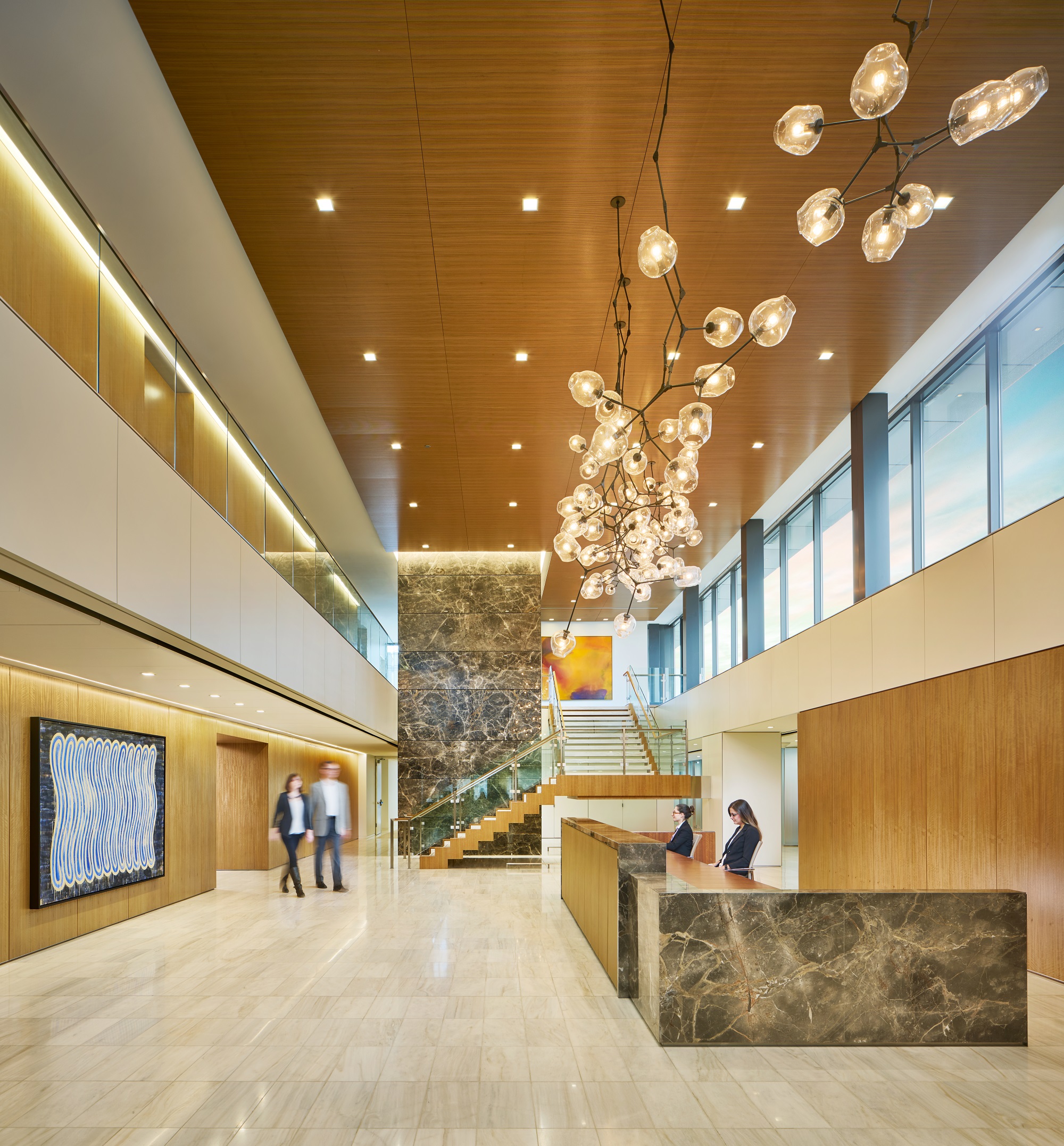
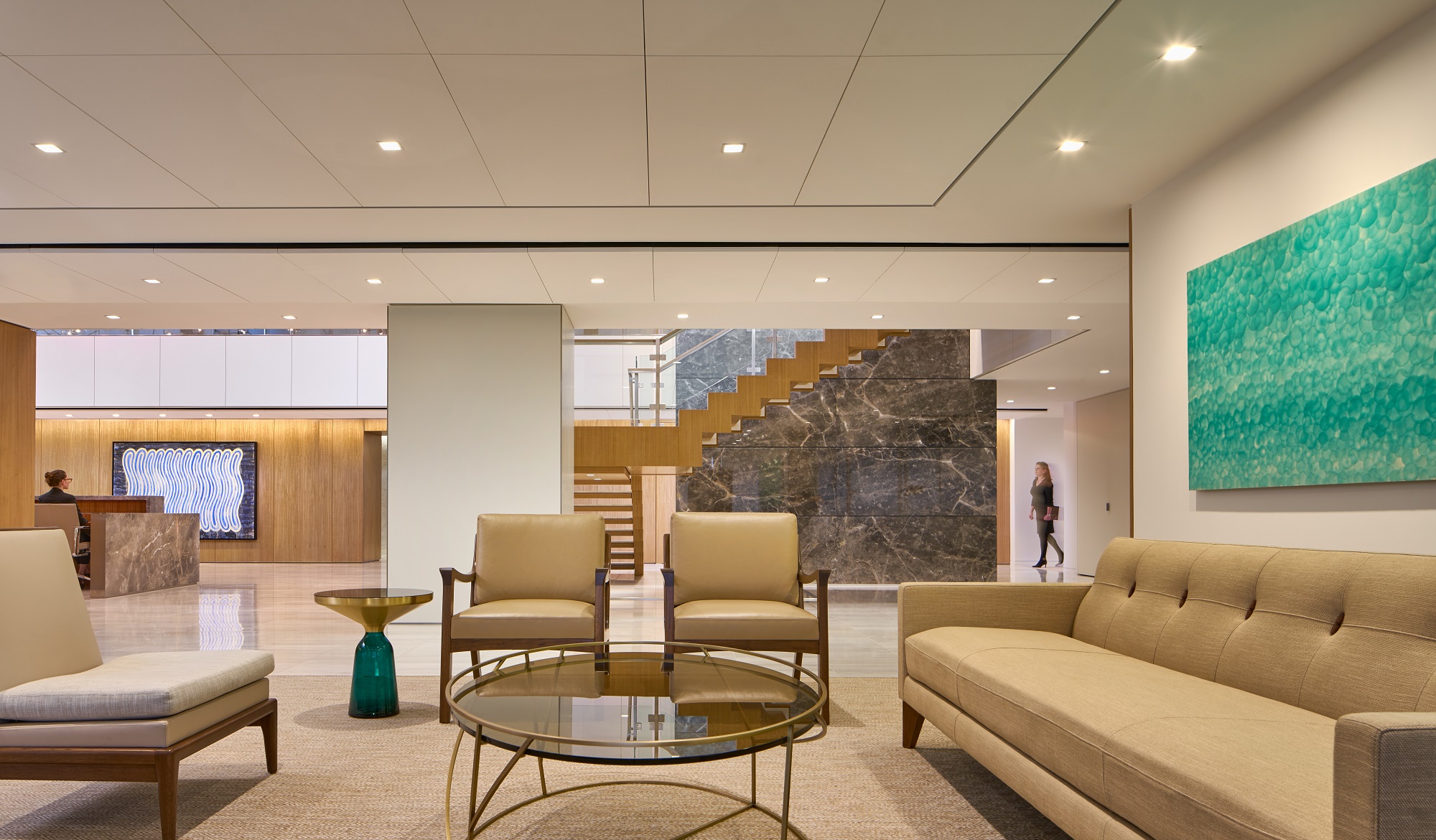
    Through the process, the Gensler team guided Hogan to a solution to better utilize its existing office space.  This solution included standardized offices and additional space efficiency strategies.  (Read all about it here and here.)  But Hogan wanted more.  They also wanted an inviting and impactful reception area and abundant multi-purpose spaces.

    Reception Area – Photograph by Christopher Barrett

    The Piece de Resistance

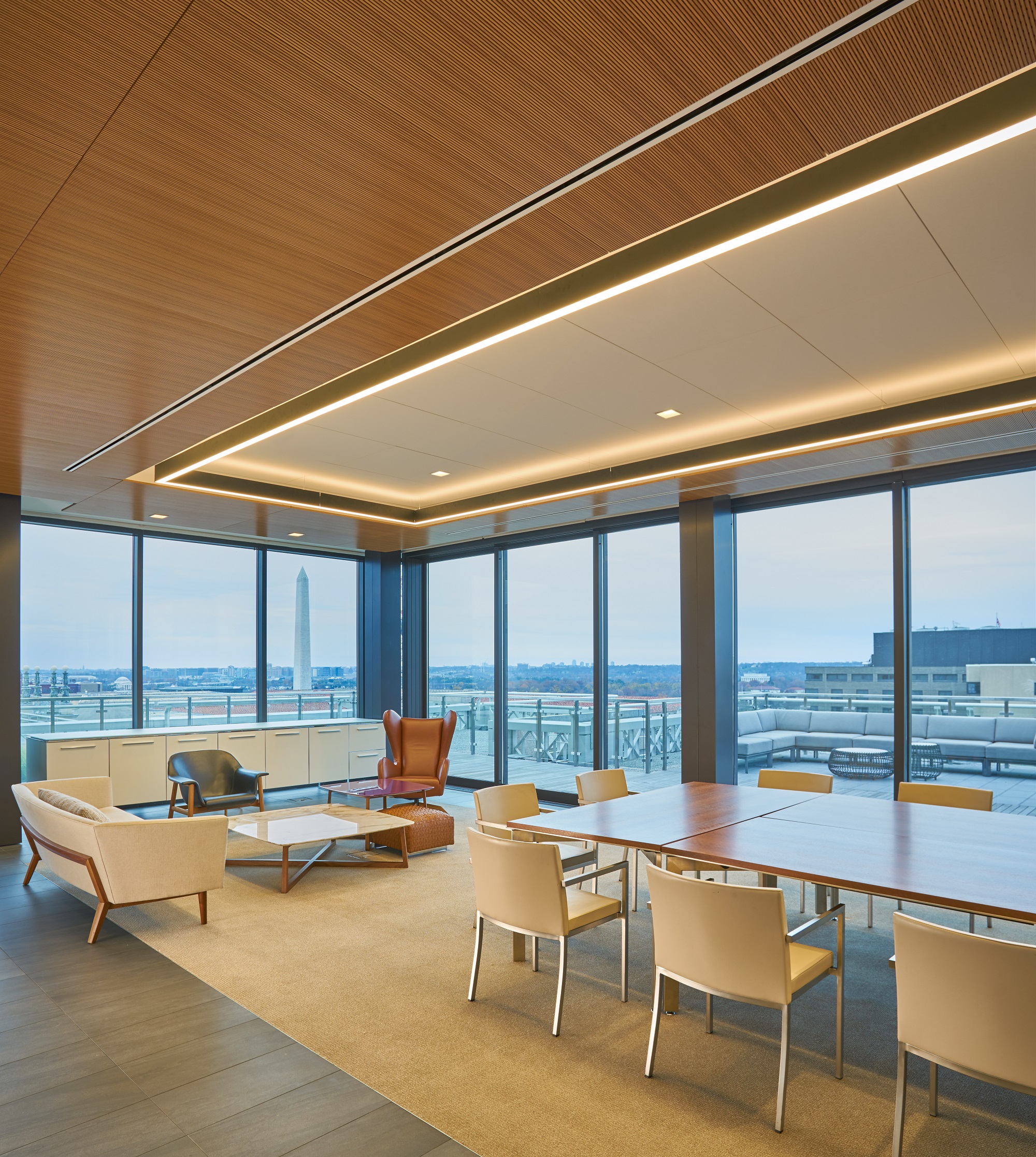
    The Gensler team, knowledgeable about zoning changes in the District that might allow additional rooftop space while not violating Floor Area Ratio regulations, suggested that the roof of the building be penetrated to facilitate the construction of a two-story lobby, 1,200 square foot rooftop glass-encased multi-purpose room and a rooftop terrace.

    Rooftop Multi-Purpose Room — Photograph by Christopher Barrett

    Hines and Hogan Lovells have a solid landlord-tenant relationship and Hines was motivated to continue that relationship as Hogan was the building’s primary tenant occupying ~350,000 square feet.  If the changes suggested by Gensler were structurally, mechanically and economically feasible, Hines’ Thor Headley knew it would be a win for both landlord and tenant.

    What Did the Economics of This Look Like?

    Ultimately, Gensler designed a plan that satisfied all stakeholders.  Savills-Studley and Hines then went to work negotiating the economic terms of the rooftop expansion.  Hines provided an allowance to build the rooftop areas as well as to renovate the lobby/reception space.  Hines did not add the enclosed rooftop square footage to Hogan’s rentable square footage, however, Hogan is solely responsible for all operating expenses, insurance, etc. associated with the rooftop space.

    Looking into the new two-story reception — Photograph by Christopher Barrett

    The results?  Check them out yourself.  I would say this project was a resounding success.


  • How Big Are Attorney Offices in the Latest Legal Spaces?

    How Big Are Attorney Offices in the Latest Legal Spaces?

    It is common knowledge in the legal industry that law firm offices built 5+ years ago predominantly still contain large (240 square feet plus) partner offices and typically only slightly-less-large associate offices (180 square feet).

    My question is: If a law firm is building out new space in 2019, will it use these same standards?

    The answer: Not in Washington, DC.

    Last week, I spent a few days touring some recently built out law firm offices in DC with Gensler’s Steve Martin[i] and let me tell you: DC firms are getting strategic with how they occupy space. These firms realize that while lawyers want the privacy and quiet they associate with private offices, they are less concerned about the size of their offices.

    So, the office size decision usually boils down to two questions.  The first:

    Should partner and associate offices be the same size?

    Traditionally, larger offices were a perk associated with earning partnership, but this perk is not without its challenges.  It necessitates the regular moving of associates into larger offices upon promotion.  It creates office inventory control issues resulting from fluctuating ratios of partners and associates.  And, it perpetuates a hierarchy from which some firms are trying to distance themselves.

    Standardizing attorney offices to one size helps avoid these issues and may generate rent savings –depending on the size of the new standard office and the partner to associate ratio.  For instance, if a firm goes from 240 SF partner offices and 180 SF associate offices to a standardized 200 SF office and the ratio of associates to partner is 5:1, the average office size increases from 190 SF to 200 SF.  Although move costs may decrease, rent costs increase.

    If that same firm goes to a universal 140 SF office, there is a significant rent savings associated with a decrease in average office size of 50 SF.

    So a firm needs to ask the second question: How big should each office be?

    Office size is not solely determined by the firm’s desires. It is impacted by the firm’s leverage ratio, the window mullion width, the depth of the floor plate and other building footprint characteristics.  It is also impacted by the furniture solution used by the firm.

    Traditionally, many firms allowed their partners to select and purchase their own furniture.  Going to a smaller office size could render that furniture unusable  – potentially a problem for some partners who are attached to the style and configuration of their furniture.  Often when going to a new office size, a firm opts to purchase new furniture for all offices to ensure fit and functionality.

    ONE SIZE FITS ALL

    Hogan Lovells is a great example of a firm that has embraced the one-size office.  Across their offices (read about Denver here), Hogan is migrating to a standard 165 SF office for all attorneys.

    In DC, the firm worked with Gensler to use this and other space strategies to reduce its total space from 500,000 SF to 400,000 SF while increasing its attorney headcount.  The firm now boasts an admirably lean square footage per attorney.

    How did Hogan Lovells and Gensler accomplish this?  They built standardized 10’ by 16.5’ offices for all attorneys giving each attorney 10’ of exterior glass.  In addition, each office has a clear glass wall facing the interior corridor.

    Hogan Lovells DC
    Hogan Lovells’ standard office photographed by Christopher Barrett

    The firm’s attorneys are given the privilege of selecting the furniture solution that works best for them from a kit of options which include small sofas, tables and guest seating.

    Hogan Lovell’s interior offices house paralegals and other support staff and are each exactly one half the size of the attorney offices.  Gensler and Hogan Lovells were very intentional in this design as it enables the firm to respond to increases in demand for attorney offices by combining two of these into one attorney office, albeit interior.  Like all other offices at Hogan Lovells DC, these interior offices have full glass fronts.

    Hogan Lovells’ Genius Bar

    Hogan Lovells and Gensler also improved density and efficiency by decreasing the number of coffee stations per floor, instead building a central “hive” on each 60,000 square foot floor.  [See photo at top of page.] The Hive’s intent is to increase interaction across each floor and encourage employees to get out of their offices and collaborate.  Each Hive includes a high-end espresso machine, soft seating, televisions, a genius bar and a pantry.

    The Hive’s Fun Side at Hogan Lovells

    NOPE, NOT HERE

    While the one size fits all option is great for some firms, it doesn’t work for others.  It is especially hard to adapt when a firm is refurbishing existing space but does not want to completely re-stack.

    I toured another global law firm’s DC office where the firm focused on improving the public spaces but did not wish to re-stack attorney floors.  Completed in 2018, this award-winning Gensler-designed space is stunning.  It includes a multi-purpose room that can seat 200 around tables, a board room with a table that seats 34 and interior glass staircases connecting all three floors.

    In this firm’s offices, all attorneys’ offices are on the exterior glass and (prior to the renovation) had hard walls fronting the interior corridor.  As part of the renovation, these offices were modified to include full frosted glass fronts facing the interior corridor.  However, they were not resized.  As such, the partners occupy 225 square feet offices while the associates occupy 150 square feet offices.

    As the firm was running out of office space, it instead chose to ask first year associates to share offices.  It also asked that retired partners give up their permanent offices, instead borrowing vacant offices for a day if their needs dictate.

    An Open Plan Approach – The Neighborhood

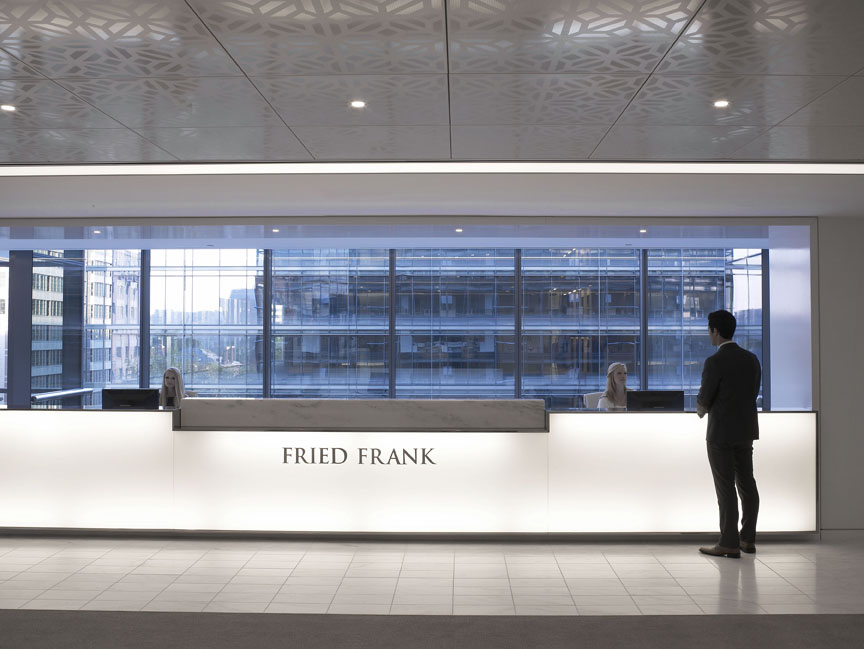
    Fried Frank was also space-challenged when it renovated its DC offices.  With Gensler, Fried Frank considered different options to accommodate its attorney growth, ultimately opting against both adding space and re-stacking its existing offices (225 SF for partners and 140 SF for associates).  Instead, in order to create space in the firm’s existing footprint, Gensler and the firm identified a support area that was underutilized and turned it into The Neighborhood.

    The Neighborhood
    The Neighborhood at Fried Frank photographed by Kenneth Ritter/Gensler

    The Neighborhood is an open plan space with 20 workstations for summer and first year associates.  It also has a small conference room for private meetings or conversations, soft seating around a television monitor, a board game shelf and a standing height meeting table.  All workstations have sit/stand desks and are outfitted with curved monitors.  As a final selling point, every inhabitant of The Neighborhood is gifted top-shelf Sony noise-canceling headphones upon move-in.

    Gathering space in The Neighborhood photographed by Kenneth Ritter/Gensler

    How has the neighborhood been received? So well that the firm administrator has heard first years voice some reluctance to leave the camaraderie associated with it.  The energy level is high and it is evident strong relationships are being built.  A big win for Fried Frank!

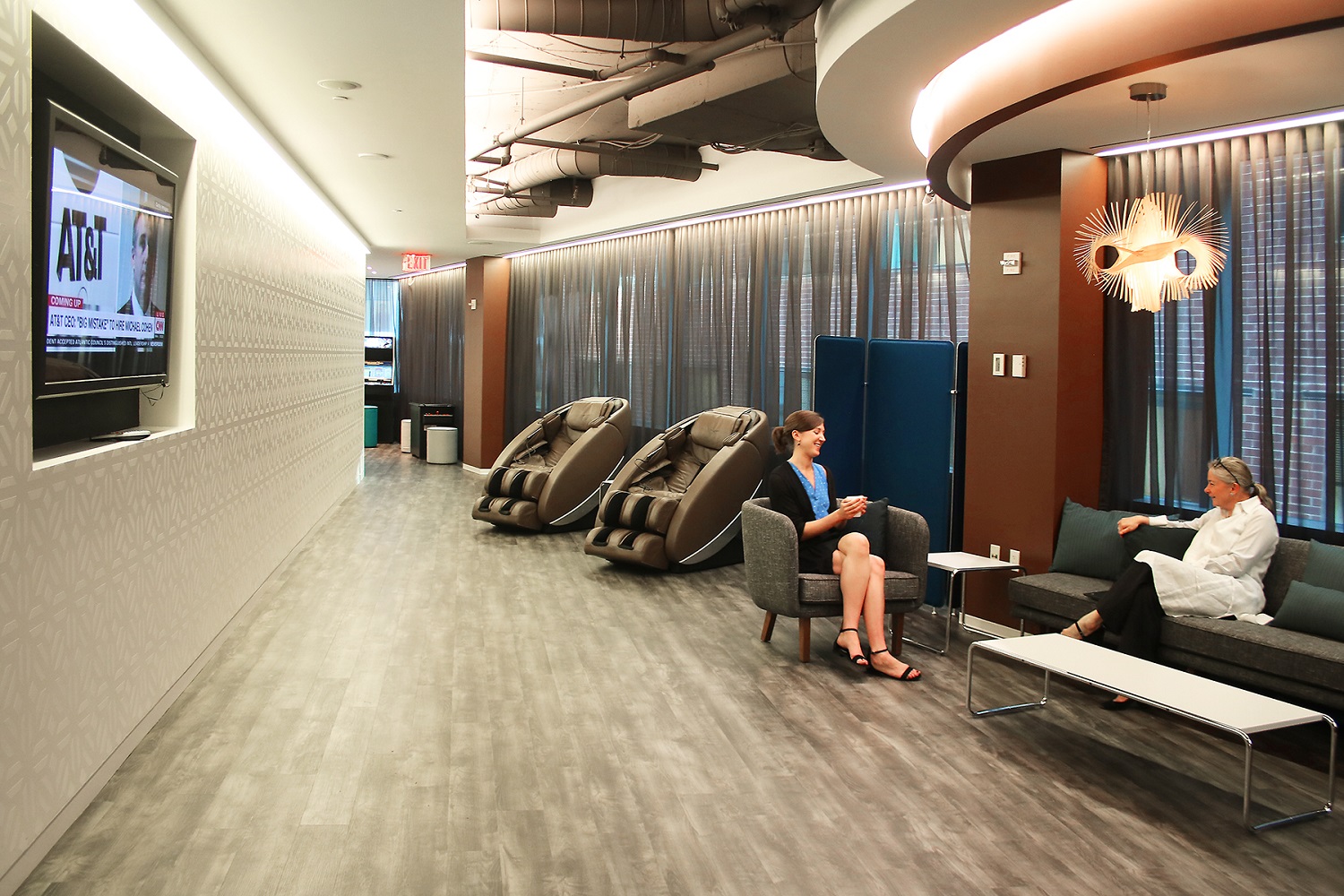
    Fried Frank’s lounge – complete with massage chairs photographed by Kenneth Ritter/Gensler
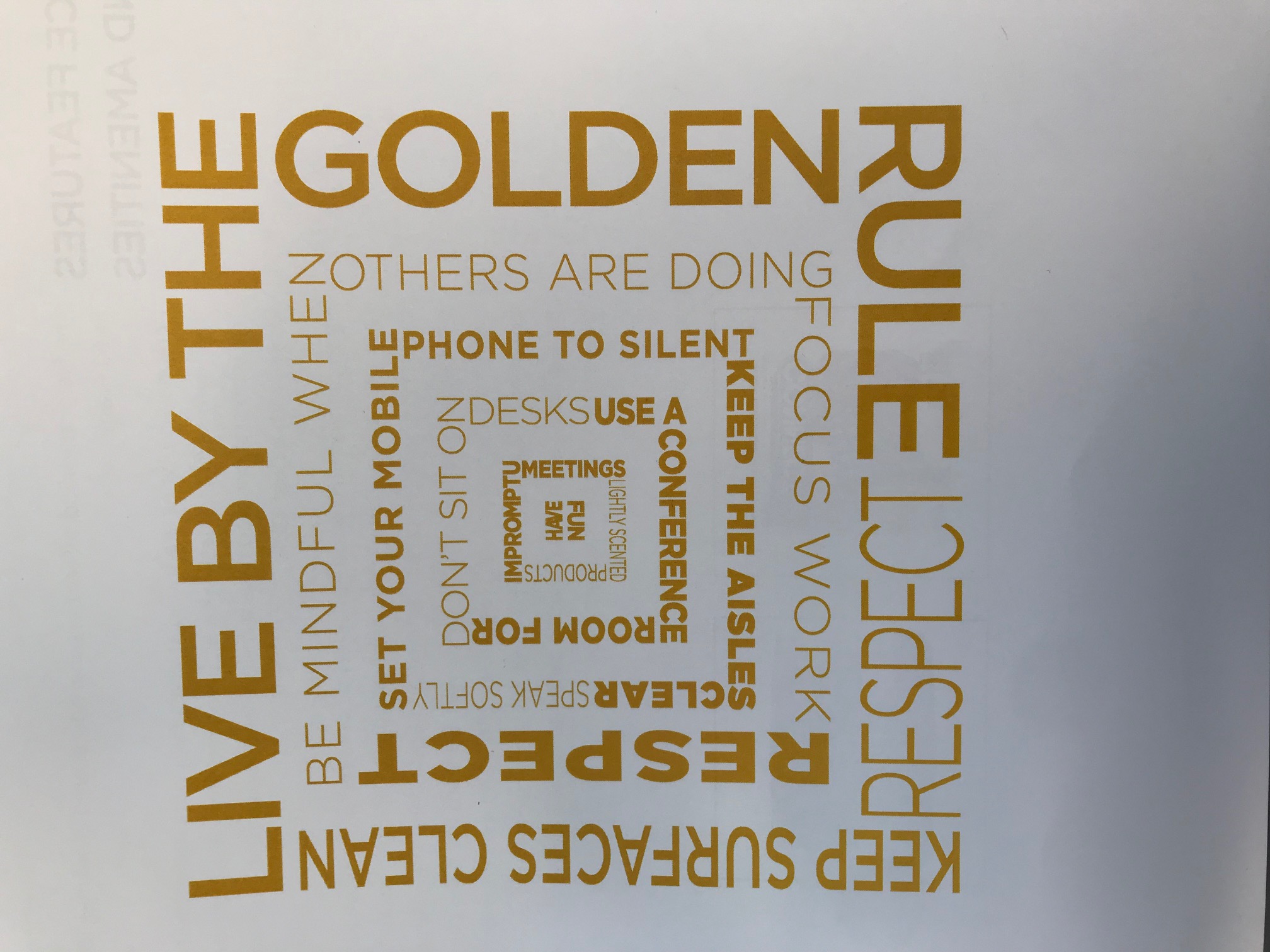
    Etiquette in The Neighborhood at Fried Frank

    So, what’s happening in Birmingham?

    I spoke with Stephen Allen at Williams Blackstock as he has recently designed new Birmingham offices for Huie Fernambucq, Lloyd Gray and Hand Arendall.

    Allen said all of these firms went from very traditional and spacious hard-walled offices to more modestly-sized, light-filled glass-fronted offices.  The attorney offices in these new spaces range from 115 square feet to 150, dictated by the window and column spacing as well as bay depth.

    Lloyd Gray’s Birmingham Offices

    The common theme is universally-sized offices for partners and associates.  This promotes a more egalitarian culture while it also decreases costs associated with in-office moves.  And what the offices lack in space, they make up for in light and design.  New furniture is standardized and selected to provide the best working environment for the occupants.

    Hand Arendall attorney office in the Historic Federal Reserve Building

    According to Allen and the attorneys with whom I have spoken at some of these firms (more on that here), the new designs have been very well received by all employees.

    Bottom Line

    An attorney’s clout within the firm is slowly, but surely, being dissociated with the size of their office. Also, more and more law firms are publicly acknowledging that their firm’s value is based on contributions of attorneys (both partners and associates) AND business professionals, support staff and other employees.  Consequently, firms and their architects are working to design space that enables every employee to do their best work for the firm.

    In DC where rental rates often approach $100/SF, being smart about your space is a necessity. Firms spend money on things that generate value – which are not necessarily 240 SF offices.  They use the money saved on rent to provide more amenities to their employees, recruit new talent, and/or innovate.  Then they measure employee satisfaction and productivity and pat themselves on the back.  Is it time for your firm to follow suit?


    [i] You will notice a common denominator in this post – Gensler. I am fortunate enough to have a friend in Steve Martin with Gensler, who generously took time out of his day to be my ultimate DC tour guide during my recent trip. He knows I am a geek about law firms and space utilization and he exhibits both immense patience and generosity.


  • Would You Share an Office With Someone?

    Would You Share an Office With Someone?

    When I started at Corporate Realty last year, I was given a lovely large office, albeit one with no ceiling and one full glass wall.  Result: quiet and visual privacy are arguably absent.  I also inherited a brokerage partner who I have written about previously, Emily Byrd.

    Emily had a workstation of her own with two large screens she could use when she docked her laptop.  However, our co-workers quickly tired of my and Emily’s loud conversations across my aforementioned ceiling-less office to her workstation.  So, notwithstanding the existence of her private workstation, we quickly found that Emily spent 95% of her time in the Corporate Realty offices in my office.

    Here’s the situation.  I’m twenty plus years into my professional career.  I do work that requires me to be on the phone a lot.  I also do work that requires intense focus and concentration.  But I have a partner that shares my transaction workload.  We partner on Every. Single. Deal.

    What This Looks Like

    So now it’s our office.  And while we have a large desk, we don’t have enough space or outlets for Emily to have both her screens on the desk so she has sacrificed that perk to co-locate.  I have sacrificed a little personal space, but honestly, work really isn’t about personal space, right?

    And most of the time, this arrangement works really well for us.  Emily and I each have different strengths, so it is incredibly convenient to be able to look across the desk and ask each other for help/advice/pep talks in real time.  We both operate at about the same level of neatness, so a few paper stacks on the desk don’t really bother either of us.

    I Mean What This REALLY Looks Like

    Our desk on a typical day

    The Why

    We also learn a lot  from each other.  I have a few more years in the business than Emily and a legal back ground, so I can teach her from my experience.  Emily, on the other hand, is incredibly resourceful and can find out anything about anyone or any property.  (As far as I know, she mostly uses this power for good.)  And she has been kind enough to share her knowledge about how to do this with me.

    We also learn through the process of teaching each other.  Sometimes when you have to teach something to someone, it makes you process your thoughts in order to put together a more understandable explanation for that person.  In the process, you come to a better understanding of the subject.

    Taking Off the Rose-Colored Glasses

    Some of the challenges of a shared office? I don’t have Emily’s 34 year old metabolism so if she doesn’t stop eating junk food  at our desk 10 hours a day, I am going to be a much bigger girl this time next year.

    Also, neither Emily nor I use a landline, primarily because the nature of our jobs means we are out and about a ton and cell phones are the easiest way to reach either of us at any given time.  Emily has taught me the beauty of using my mobile phone’s speaker option so I can (1) easily take notes on a call and (2) not have to recap everything to Emily the second I get off the phone with a client or landlord.  However, there are times I don’t FREAKING WANT TO HEAR WORDS ANY MORE  so occasionally, I might nicely ask Emily to take her phone off speaker.  Nicely.

    The Bottom Line: Sharing With Emily Is Better Than Not Sharing With Emily

    A little side benefit to our shared office scenario is the obvious cost savings to our company created by improved density.

    Are we the first to do this?  Definitely not.  I believe the practice originated in the U.K. where experienced lawyers shared their offices with apprentices so that the apprentice could learn from the master all day, every day.

    But in the U.S., we tend to see more companies approach the office/no office decision as binary.  Either someone warrants a private office or they warrant a workstation.  Rarely is the shared office given consideration.  Maybe it’s time to rethink that.  It works for us.

  • Why Notice Addresses Matter

    Why Notice Addresses Matter

    Your notice address is not a sexy topic, but it’s one that needs to be discussed. Give me two minutes.

    The Set Up

    • Your landlord doesn’t receive your rent check.
    • Space contiguous to yours becomes available and the landlord knows you might need more space.
    • You park a truck, car or horse & carriage at your building overnight and that action constitutes a default under your lease.

    All of these are instances where the landlord might need to give a tenant notice.  And all leases dictate how notice is to be given.  This notice language works great when the tenant only has one location.  If notices go to the tenant at that location, the tenant is assured of getting notice and curing any defaults or exercising any option rights.

    The Issue

    A problem arises when a tenant has more than one location.  If each of a tenant’s different leases states that landlord must give tenant notice at that specific location and that location is a remote office which is either not regularly staffed or staffed with Billy Bob who doesn’t know how to handle such a notice, the odds of the notice being received by someone who will act on it are slim.

    An Example

    Suppose a landlord sends the tenant notice of a change in rent payment address and that notice goes to the local office.  Further suppose the tenant’s headquarters does not receive this information and so it sends rent to the previous rent payment address.  As a result, the landlord does not receive rent.

    The landlord then sends notice of default for nonpayment of rent to the tenant at the local office.  Again, the employees at the local office (Billy Bob) don’t know what to do with this notice so they make a bunch of phone calls over a two-week period trying to figure it out.  By that time, BEST CASE, the landlord accepts a late payment with penalties and late fees.  WORST CASE, the landlord declares tenant in default and pursues its remedies up to and including lease termination.

    The goods news?  This is an extremely easy problem to both fix and avoid.

    Avoid the Problem

    When you enter into new leases, dictate that all corporate leases have the same notice address (headquarters; not Billy Bob at the local office) with a copy to general counsel or outside counsel.

    Fix the Problem

    To fix existing leases, send a form letter to all of your landlords (making sure you use the correct landlord notice address) stating that going forward, all notices to tenant must go to headquarters with a copy to general counsel or outside counsel.

    If you want to make sure you never miss a notice date yourself, read this!


  • Thanksgiving 2018: Downtown Edition

    Thanksgiving 2018: Downtown Edition

    It’s almost Thanksgiving, and man, am I thankful. 2018 has been a year of big career changes for me and I look back on all of them with tremendous gratitude.

    A Sabbatical

    This was the year I left big brokerage after 21 years.  While I had some of the best mentors at JLL, Staubach and Colliers and they were great places to learn commercial real estate, I needed a change.  I am immensely grateful for the ability to take a leap of faith and leave my previous position in April without knowing what my next step was going to be.  I had the good fortune of being able take a short sabbatical to figure out what the next right thing for me was.

    Not being one to sit still for long, it took me the first two full weeks to truly relax, but it was pure heaven.  I exercised (a lot), read (a lot), hung out with my family, and even binge watched a little Netflix.  But, I was restless and  needed a new mountain to climb.  And I missed my clients.  I saw this sign in an office this year:

    It hit home.  I was ready to get back to work.

    A New Challenge

    In that vein, I owe a big debt of gratitude to Meredith Calhoun, who recruited me to take her place as COO of Corporate Realty as she left to pursue her entrepreneurial dreams.

    Meredith and Corporate Realty CEO Robert Simon shared their vision for Corporate Realty with me and convinced me (someone with no experience in development) that my unique background could be of value in helping achieve this vision.  They also helped me realize that this role would give me the perfect opportunity to continue growing professionally.

    Professional Women and the Men Who Love Them

    On my first day at Corporate Realty, I was immersed in development and brokerage meetings.  And each meeting contained numerous strong, smart, professional women.  If commercial real estate is not your world, you might think this is no big deal, but I assure you, it is.  Especially in the South.

    I soon learned that all of the men working at Corporate Realty are married to strong, smart women and they clearly value this about their wives.  This is so evident in our office culture.  I have never worked on such a level playing field in my life and it is a game changer.  If your company isn’t there yet, keep pushing.  It’s a goal worth achieving.

    Downtown BHM

    I am oh so thankful to be back in a downtown office.  There is so much energy and activity in downtown Birmingham these days and it is a ton of fun to be a part of it.

    Speaking of downtown, this year, I was introduced to the team at Orchestra Partners.  Holy he11.  This young Birmingham development company is betting on Birmingham in a big way and it is super inspiring.  Pay attention.  Support their efforts.  We need people like them.

    My Work Wife

    I am also thankful to have a true brokerage partner in Emily Byrd; she’s the sh*t[i].  We share an office, a workload, a ton of laughter and a love of French fries.  And on the downtown Birmingham note, I am grateful for Carrigan’s French fries, to which Emily introduced me.  If you haven’t had them, you are missing out.

    Chocolate at Work: A Mixed Blessing

    I used to be grateful for Corporate Realty’s chocolate drawer.  Yep, drawer — we have a huge file drawer full of chocolate.

    Now I am thankful for my co-worker, Becky Carpenter, who – like me – realized having access to a drawer of chocolate wasn’t always a good thing.  We made a pact to stay out of it until Christmas.  And we put teeth into that pact:  Becky and I each wrote a check to the Birmingham Education Foundation, a cause we are both passionate about.  We also each wrote a check to a cause we affirmatively do not support and with which we never want our names associated.  If we make it to Christmas without hitting the drawer, the Ed Foundation checks get cashed.  If either of us capitulates, that person’s check to the “bad cause” gets cashed and she will be on record as a supporter.  We call it “the nuclear option.”  So far, so good.[ii]

    [i] Editorial emphasis added by proofreader, Emily Byrd.

    [ii] By the way, Chocolata chocolate was deemed an exception to this pact as (1) it is a delicacy in which you cannot possibly overindulge and (2) when you have the opportunity to eat Chocolata, you should most certainly do so.


  • What Does “Turnkey” Mean?

    What Does “Turnkey” Mean?

    Many landlords promise prospective tenants a “turnkey” buildout, meaning the tenant will show up on the date its lease commences, “turn the key” and walk into finished space.  The landlord determines the costs it is willing to incur for this turnkey buildout based on the rental rate and term length, however,  the actual dollar amount of that turnkey buildout is seldom disclosed to the tenant.

    A problem arises when the draft lease stipulates a turnkey buildout and references nothing more than a simple test fit drawing indicating where offices, doors, kitchens, and conference rooms are located. The tenant may be expecting glass-walled offices, a kitchen with upper and lower cabinets and appliances, hardwood floors, and high end lighting.  The landlord may deliver sheetrock office walls, rolled carpet, fluorescent lighting, and a bare bones kitchen with holes where the refrigerator and microwave the tenant is expected to buy will go.

    Also, there will usually be insufficient teledata and electrical outlets.

    It is crucial that tenant advisors walk their clients through the process of  defining turnkey prior to lease execution.  It is also in the landlord’s best interest as it ensures that everyone is on the same page and there is no mid-construction conflict.

    What do we need to address to define Turnkey?

    Walls and Doors

    Identify where walls will be located and whether or not those walls go all the way to the deck.  (Note, walls built to the deck provide much better sound insulation but also cost more to build.)  Define the locations of doors, sidelites, and glass.  Stipulate the door heights.

    Expensify Portland – definitely not “turnkey” walls

    Lighting

    Ask where the lighting is going to be located and what type of lighting will be installed.  Will it be energy efficient such that it will turn off when there is no one occupying the space?

    Ervin and Smith – probably not “turnkey” lighting

    Kitchens

    Will there be a kitchen?  Will have it plumbing so that you can draw water from a faucet?  (Trust me: wash your coffee pot in one of the building’s bathroom sinks for a day or two and you will understand the importance of a kitchen sink and faucet!)  Will there be upper and lower cabinets?  What is the counter material?  Will the landlord provide appliances?

    Airbnb’s Paris Kitchen Conference Room – in my dreams, this is my “turnkey” kitchen

    Flooring

    What will the flooring be throughout the space?  If you are going to have carpeted areas, is the carpet going to be carpet tiles (MUCH easier to replace worn areas in the future) or rolled carpet?  If you are going to have concrete floors, will they be stained?  Finished?  What is the kitchen flooring?

    KSGB lobby – nope, probably not going to be turnkey

    Baseboards and Molding

    Will the space have rubber base or wooden baseboards?  Will the offices (or even just the conference rooms) have crown molding?

    LinkedIn Paris – if this is turnkey, I don’t want to see the rental rate

    Outlets

    Where are your electrical outlets and how many will there be in each office?  Will the landlord install teledata outlets and just let the tenant’s contractor pull the actual cable?

    Venable – This is probably turnkey if you want to pay rent on the patio

    System Upgrades

    If the space is second generation and any building systems need to be updated, will that be done and will landlord bear those costs?

    Furniture Move Costs

    If you already occupy the space and the landlord is promising to provide new carpet and paint “turnkey,” does the landlord plan to cover the cost of moving the existing furniture to allow the work to proceed?  Will the landlord cover the cost of that work happening during non-business hours, i.e. when landlord’s labor costs are higher?

    Is All of This Really THAT Important?

    Yes.  Absolutely.

    First, read this discussion of the five interior finishes that make a Class A build-out Class A.

    These things matter.  Sound proofing matters.  And cost differentials are big.

    Nobody like surprises.  If you take the time to define turnkey ahead of construction, everyone knows what to expect and nobody gets an unexpected bill.