Author: Anita Turner

  • It All Happens Around the Table

    It All Happens Around the Table

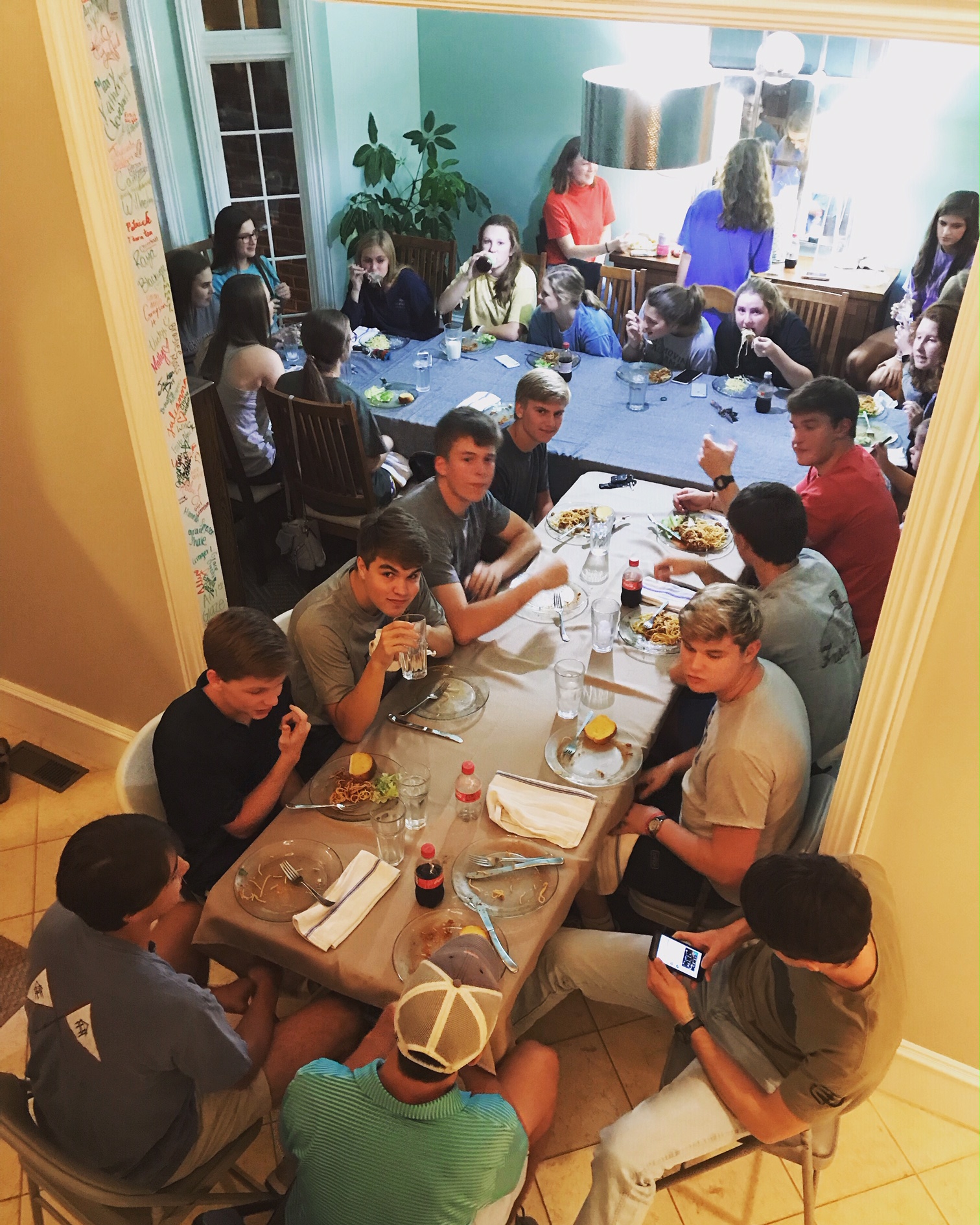
    It’s 6:45 on a Monday night.  I am in our family kitchen checking the lasagna,  frantically tossing salads and slicing garlic bread.  The table in our dining room has been extended with a card table at one end and a folding table perpendicular to one side.  Table cloths are in place; cloth napkins and forks are at every one of the 24 seats and spare napkins and forks are stacked for any surprise guests.

    The front door is unlocked because on Monday nights, our house is everyone’s “home” and kids can just walk right in. Within fifteen minutes, our kitchen, living room and dining room will be full of hungry kids.  Places are being staked out at the table with cell phones and car keys.  Kids are catching up with their friends, and my husband and I are getting ready for the cattle call.

    This is Family Dinner.

    For going on four years now, my family and I have hosted dinner in our home for a gaggle of high school seniors every Monday night.  This tradition began in 2016 as a happy accident when a couple high school girls from our church came over to welcome an intern who would be living with us for the summer.  They stayed for dinner, enjoyed it, and Family Dinner was born.

    The initial two girls invited two friends, who invited two friends and you know the rest.  Three months in, we were averaging 8 to 10 kids every Monday night.  As it turns out, teenagers like hanging out with a family – especially one that isn’t their own.  We kept it up for the entire school year thinking it would end with graduation.  Those kids – the Family Dinner Class of 2017 – weren’t having it, so we continued through the summer until they all left for college

    Towards the end of that summer, the kids began insisting that we do this for the next class of seniors.  To our surprise, our kids (then in 7th and 9th grade) had come to love it as much as my husband and I did and begged us to keep going, so the family was all in for another year.

    I coordinate the crazy by sending out a GroupMe every Sunday asking the kids to like the message if they’re coming.  This trick gets me a headcount that is about 95% accurate.  It also makes for an interesting text trail as the year goes on and they get more comfortable with us.  (We had a whole video exchange one year when a girl couldn’t figure out how to kill a spider on her ceiling.  I was DYING laughing at the kids’ strategies and comments.)  And, the GroupMe conversations live on after the kids go to college –an awesome way to stay in touch.

    I cook a range of dishes from scratch because I want it to feel like a traditional “family dinner” but please know that if you decide to try Family Dinner yourself, you can do it low brow and cheap and the kids will still show up and eat every bite.  In fact, I think their enjoyment of the food is inversely related to the time and expense that went into making it.

    We kick everyone out by 9:30  because SLEEP.

    My husband and I are “around” and, as the year goes on, the kids spend more time hanging out with us and talking to us about their problems/successes.  And, we are fortunate that many of them still come by and see us when they are home from college – even spawning “Reunion Family Dinners” during the holidays.

    Last Day of Family Dinner – Class of 2018

    Other than starting my own family, this might be the single most fulfilling thing I have ever done.

    Also, I have found Family Dinner translates to my career.  I have hosted numerous dinners in my home to connect clients, colleagues, and friends with each other and absolutely nothing compares to a fun relaxed dinner in your home for establishing relationships between people.

    Family Dinner – Ladies’ Version

    Try it.  Let’s start a Family Dinner movement.

  • How to Build Business By Giving it Away

    How to Build Business By Giving it Away

    I recently read a blog post about the importance of client trust to business development and it really resonated with me.  Written by Tara Weintritt at the Wicker Park Group, I encourage you to take two minutes to go here and read it.

    I thought about what Weintritt had to say in the context of my real estate and legal careers.

    “We can do anything… for revenue.”

    When I started working at JLL 24 years ago, one of the managing directors in the office told me that if anyone ever asked me if JLL provided “X service,” to say “Yes” and we would figure out how to provide that service later.  For a long time, I thought this was a great approach.  But JLL was a big (soon to be enormous) firm and we legitimately had the resources to provide most real estate services.  It was usually just a matter of researching where in the company we had the expertise.

    I have since changed my position on this.  I think the best answer if you don’t know if your company or firm can provide X service, is to say “I don’t know.  Let me find out if we can help or — if we can’t — who would be the best person outside of our organization to do so.”

    This applies across industries but my experience is germane to the legal and real estate industries.

    Or, we could think about the client.

    I most recently worked at a small real estate firm in Birmingham.  We had a tiny brokerage team and between my partner and I, we were REALLY good at office tenant rep and building purchases and sales.  We were not industrial experts.  I was not a retail expert.  And I am not a great landlord representative because my whole career has been devoted to the tenant side of the equation.

    As a result, I turned down some revenue-generating work that me and my firm probably could have used because I didn’t think I was the best person to do it.  But you know what invariably happened? Turning down work (and referring clients to other brokers) invariably earned me my client’s trust and loyalty.  Ultimately, this meant they sent me a bigger proportion of their office work.

    I have also encouraged clients to do shorter term deals or lease a smaller square footage when I thought it was in their best business interests knowing that it meant a smaller commission for me.  Not only was it the right thing to do, but it always paid off in increased client loyalty.

    From the legal side, I have had real estate clients who sent draft leases to their attorneys for review.  I would get the red-lined leases back and wonder if the attorney reviewing them had ever looked at a lease in their life.  Inevitably, I would find out that the client’s general business attorney had done the comments themselves – even though they had no experience with commercial office leases and even though they had real estate attorneys in their firm that did – just to keep the billable hours for themselves.

    The Long Game

    This is (and was) short-sighted.  One of those clients ended up moving all of its business to another firm because they were so frustrated with paying legal fees for useless lease reviews.  If instead their general business attorney had said “I am not experienced in this work but know someone who is great at it.  Would you like me to connect you or contact them directly?” my client would still be working with the firm.

    The lesson:  Make sure your clients have the exact right person working with them on each and every need – even it it’s not you – and over time, it will come back to you with increased client loyalty and trust.  Play the long game.

  • Small Innovations Are Still Innovations

    Small Innovations Are Still Innovations

    I just finished The Art of Innovation: Lessons in Creativity from IDEO, America’s Leading Design Firm at the recommendation of Dave Gray.  (See more of his recommendations here.  You cannot go wrong with any of his suggestions.)

    While written in 2001, this book is still very relevant today.  As evidence, in the book, the authors discuss how they would improve the check-in and departure process at airports.  Virtually every recommendation they made in 2001 is in effect in airports now.

    Little Improvements Matter

    One important point in the book is that not all innovation is of industry-disrupting scale.   As an example of this, the authors discuss the JanSport backpack company.  When customers return backpacks for repair, the company mails out postcards stating:

    “Hi! Warranty Service Camp is really cool.  They say they’re sending me home soon.  Gotta run… we’re doing zipper races today!”

    While this is arguably very silly, JanSport reports that nearly all of the correspondence the company receives now consists of cheery thank-you notes rather than angry customer letters.

    What one small thing could you do today to improve your law firm clients’ experience? 

    End-Of-Project Awards

    Here’s an idea from the book applied to the legal industry: end-of-project awards.  (I am not talking a lucite for your desk shelves.)  Imagine that at a closing dinner for a major deal, instead of just running up a big bar tab and making small talk, you awarded the various deal participants (lawyers, business people, etc.) in a way that makes light of a blunder or “cleverly captures the heart of an individual’s achievement.”  As an example, one of IDEO’s studio heads sent a reversed drawing to a tooler; “his award was a mirror on a plaque.”

    End-of-project awards create a memorable experience and the clients go home with fun tchotchkes that will forever remind them of the positive experience of working on a deal with you.

  • Must Read Books: Law Firm Client Service

    Must Read Books: Law Firm Client Service

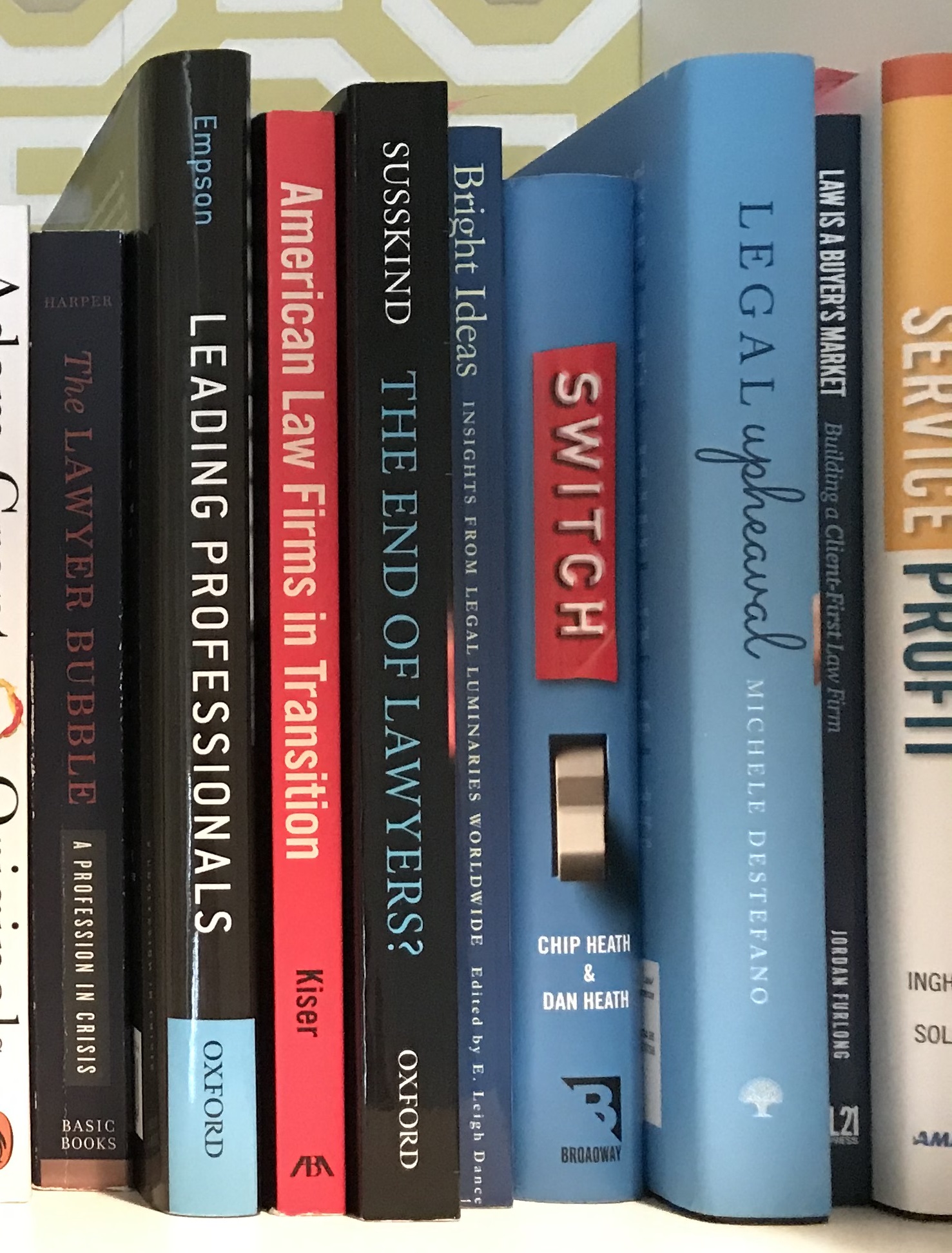
    I have been doing a lot of reading lately on the need for law firms to refocus their strategy on the client.  This refocus includes everything from better understanding the client and the client’s business to providing an exceptional client experience.  For those who are as interested in this subject as me[i], here are some of the books I have found most valuable along with some small lessons from each.

    Why do law firms need to refocus on the client?

    In short, because clients are asking for it, and they are going to start asking more loudly. And you can’t increase revenue without clients.

    American Law Firms in Transition: Trends, Threats and Strategies by Randall Kiser is an incredible primer on many hot topics in the legal industry.[ii]  It includes this summary of an ALM Legal Intelligence survey of law firm leaders: “’Growing the firm’s revenue’ is the highest priority for law firms.  But only 56 percent of firms have a ‘plan in place to build, track and measure client loyalty and satisfaction.’  Only 21 percent of leaders would like to ‘provide higher service levels,’ and only 9 percent would like to ‘institute client satisfaction surveys/interviews.’  Increasing revenue without tracking and improving client service strikes most people in business as incongruous, if not impossible.”

    This means that law firms are relying on raising rates and billing more hours as their primary means of increasing revenue – probably not a sustainable long term strategy.

    Another of my favorite Kiser observations is this: “Although attorneys try to impress new clients with their competence, clients are seeking answers to three threshold questions: Can I trust you? Do you care about me? Are you committed to my success?”  As a former lawyer, upon reading this, I realized that I often default to trying to prove my competence as a qualified expert in an initial client meeting, rather than focusing on building trust and warmth.

    If we want to increase revenue, it seems logical to start with providing the buyer of our services with the exact service they want and need.  This has to be part of a law firm’s strategy.  How can we increase revenue if we are too busy proving our competence and never stop to ask clients what they are looking for?

    In Legal Upheaval: A Guide to Creativity, Collaboration, and Innovation in Law, Michele Destefano elaborates on this point, stating that the value provided to outside counsel when law firms spend time “problem finding” versus “problem solving” is significant.

    Destefano quotes the GC of a global cybersecurity company speaking about her outside counsel:  “They want to have a one hour kickoff call but really just want to suck off info from you and they are sort of listening to you but also selling themselves and it’s an hour and a half and they bill you for it and you could have found it on my website and then asked five minutes of targeted questions and that would have showed your value.”  Preach.  It is hard to overstate the value of doing your homework.[iii]

    [Note: while worth reading, Legal Upheaval doesn’t make my “ohmygosh, you have to read this” list.]


    How can we make this shift happen?


    Build trust within your firm and realize that takes time.  No one is going to listen to advice from someone they don’t trust.

    Law is a Buyer’s Market: Building a Client-First Law Firm by Jordan Furlong is an incredibly thorough study on how to shift your firm’s focus to one that is more client-centric.[iv]  Furlong acknowledges throughout the book that making this change is hard and offers this advice on the best approach: “Veteran salespeople talk about the “rule of seven touches” – it requires seven personal interactions to establish a level of trust sufficient for someone to take up a suggested course of action… Facilitating change in an organization is not that different.”

    Don’t make it about you or take credit.

    In Leading Professionals: Power, Politics and Prima Donnas by Laura Empson, Empson discusses at length the ideal people to lead law firms.[v]  One observation specifically really resonated with me: “it takes a special kind of person to succeed as a management professional within such organizations.  They need to be exceptionally good at the job but also willing to stay out of the limelight.”

    And make the shift easy.

    I read a whole book on this called Switch: How to Change Things When Change is Hard by Chip Heath and Dan Heath.  In it, the authors state “If you want people to change, you can provide clear direction… or boost their motivation and determination… Alternatively, you can simply make the journey easier.  Create a steep downhill slope and give them a push.  Remove some friction from the trail.  Scatter around lots of signs to tell them they’re getting close.  In short, you can shape the Path.”

    The Heath brothers’ lesson?  If you want to help your firm make a change, make it as easy as possible.  For example, if you want your real estate associates (and even some partners) to better understand the economics of real estate deals so they can better understand their clients’ motivations, create a lunch seminar on the topic and secure CLE credit for the time.  Feed them; provide them CLE time; and don’t take them away from their desks for more than hour.  Win. Win. Win.

    Before you tell me, “easier said than done,” I have done exactly this.  It’s not that hard.  (And if you would like me to teach your associates this commercial real estate economics lesson, send me an email.)


    What are some concrete examples of what the shift to knowing your client better and exceptional client experience looks like?


    Remember: the little things add up.

    It seems obvious to start this topic with a book named Exceptional Service, Exceptional Profit: The Secrets of Building a Five-Star Customer Service Organization by Leonardo Inghilleri and Micah Solomon.  However, to be honest, I probably would not have heard of this book if I had not attended a Law Firm COO/CFO Summit moderated by Inghilleri a few years ago.  Inghilleri’s insights were incredibly eye-opening and I was anxious to read more of them.

    In Exceptional Service, Inghilleri and Solomon discuss the collective effect of small client-focused touches. (p.72)  They warn that while a firm might believe that something like a follow-up thank you note is not valuable to the client, getting rid of it can have unforeseen ramifications.  “All of these touch points, and so many more, ultimately build an experience that is more than the sum of its parts: The collective is what does it.  That’s why the attention to details is so important in the service business: making sure that each one of those touch points is well executed.”  He adds “service-focused companies tend to delete crucial value from their service offerings, all in the name of efficiency.”

    The Power of Moments by Chip Heath and Dan Heath, echoes this sentiment with the statement:  “Beware the soul sucking force of reasonableness.”  For instance, while it is easier and arguably accomplishes the same purposes, an emailed Thank You does not make the same impact as one that is handwritten and mailed.  Reasonably, email saves time.  But it’s a compromise.  Don’t compromise.

    Over deliver.

    Another Inghilleri gem: “Don’t imagine you’re doing something special for a customer by making things how they should have been in the first place.” (p.35)  In context, Inghilleri is referring to compensating a customer for a service failure.  However, I believe it applies to all service delivery.  If you deliver only what is expected, you are not creating a client for life.

    Don’t pass up an opportunity to know what your client is thinking.

    The End of Lawyers: Rethinking the Nature of Legal Services by Richard Susskind is a must-read classic for those interested in the legal industry.  Among all of the big ideas, I found this little gem: “Most lawyers with whom I speak dismiss Twitter as yet another plaything for their children.  Of what possible relevance, they inquire, could this possible be for a senior legal practitioner?  I reply that I know quite a few General Counsel and senior in-house lawyers who now use Twitter and regularly send out messages about what they are doing, what they are thinking, and where they are going: and if my clients were sending out regular updates on their news and views, I would want to be on the receiving end, even if the medium has a slightly silly name.”

    On a related note, I suggest searching for your client’s individual and company names on the Podcast app.  If they are speaking on a podcast, you should probably listen to what they have to say.

    In the next installment of “what Anita is reading,” I will share some articles I think may be worth your time.

    Until then…


    [i] I realize I just lost 90% of my readers with this statement.

    [ii] Send me an email if you would like a copy of my extensive notes on this book.

    [iii] I preach this to my kids on the daily and it is yet to be determined whether the message is sinking in.

    [iv] I highlighted half the book as I found so much of it worth future reference.

    [v] A must-read if you are a managing partner or COO/Executive Director.
  • Shipt’s Growing Presence on the Birmingham Skyline

    Shipt’s Growing Presence on the Birmingham Skyline

    A couple months ago, I had the opportunity to do a quick tour of Shipt’s Birmingham headquarters with its new CEO, Kelly Caruso, and her team.

    Kelly is a Leadership Birmingham classmate of mine and fellow Minnesotan. She took the reigns of Shipt shortly after Target acquired the company and then willingly relocated down south to keep Shipt’s HQ in the Ham.   Thankfully, she is quite literally warming to Alabama and we are all thrilled with Shipt’s commitment to our city!

    The John Hand Building

    Shipt has two major operations in Birmingham.  Originally, the company opened on the ground floor of the historic John Hand Building in a former bank branch space.  This physical space is spectacular with double height ceilings, marble floors  and lots of light.  Shipt preserved the original teller lines (complete with foot imprints in the marble at each teller station, carved by decades of bank customers waiting to transact) and bank vaults, which are now used as conference rooms.

    Look closely and you can see feet-sized indentations in front of each teller window.

    The space is built out densely with almost no private offices.  Rather, the company chose to use benching solutions with sit/stand option to create a flexible and egalitarian culture.

    Collaboration space abounds.

    When Shipt outgrew the available office space at the John Hand Building, Shipt leased space two blocks away in a high rise office building built in the 1980s.  It has been renamed Shipt Tower, so shortly Shipt will have its name atop two signature buildings in downtown Birmingham.

    Shipt Tower

    The buildout at Shipt Tower definitely echoes the feel of the space the John Hand Building, with lots of natural light, benching, white walls and pops of Shipt’s trademakr green color. In addition, there are numerous areas designed to facilitate small team meetings and impromptu collaboration.

    All Shipt spaces feature something unique (at least in Birmingham) to Shipt – a live video conference between the break rooms of Shipt’s San Francisco and Birmingham offices.  This enables employees to be in the break room at any time of day and “run into” their West Coast colleagues grabbing a sparkling water.  Such a great way to build a connection!

     

  • The Thanksgiving Post Prompted By a Car Accident

    The Thanksgiving Post Prompted By a Car Accident

    Yesterday, on  the way from work to a holiday event, I got in a car accident.  Everyone involved was unhurt and my car suffered blessedly minimal damage such that I could drive away after all of the accident reporting was complete.

    I was uncharacteristically calm throughout the whole ordeal.  If anything, I was absolutely overcome with gratitude that everyone was OK and this accident was not going to send my family into a financial or logistical tailspin.  I remembered with incredible clarity an accident I had while I was in law school in California.  I recall freaking out about finding someplace to get my car fixed, paying the deductible, getting to work and school while I was carless, etc.  I am grateful for the lessens I learned through that experience and oh so grateful that I am where I am now.

    And so begins my annual Thanksgiving gratitude list.

    This year I am grateful for so very much.  My family for sure tops the list, but this is a professional blog so I am going to focus on that part of my life.

    Girls’ Dinners

    This was the Year of Connection for me.  In addition to hosting our weekly high school student dinners, I began hosting Girls’ Dinners for some of my personal and professional friends that I felt needed to meet each other.  It has been deeply rewarding to get to know these women better and  to watch new relationships form between them.  And what a blast we have had in the process!

    Leadership Birmingham

    I am grateful that I was selected for Leadership Birmingham this year after four years of applying.  When I met my classmates at our orientation retreat, I understood completely why I had not been selected earlier.  These people are World Changers.  I am so grateful for each and every one of them and the experiences we are sharing learning about our city, its challenges and its opportunities.

    The Powerful Women of Legal BD

    This year, I met some wonderful people in the world of legal business development — my self-professed passion pursuit.  Jill Weber generously shared some of her impressive knowledge garnered through years of being the Chief BD Officer at Stinson LLP.  Jenna Schiappacasse of Rosenberg Martin educated me through the many articles she has written and a podcast on which she spoke and then even gave me an hour of her time to answer my many questions and let me pick her brain.

    Andrea Maciejewski with Levenfeld Pearlstein continues to be my law firm marketing sensei.  She is incredibly generous with her time and knowledge.  And she is a marketing genius.  Just Google LMA awards and her name and you will understand why I make that statement.

    While in Los Angeles, I reconnected with a law school friend who is now the CMO of Stradling Yocca, Robin Gerard, and she has been such a great resource on that community, helping me identify conferences worth attending and people to learn from.

    Steve Martin

    As in years past, I am grateful to the architecture community.  Steve Martin with Gensler will always be the bellwether for thoughtfulness and generosity within this profession.  I planned a trip to DC earlier this year and he kindly set up a morning of tours of the most interesting law firm build-outs in town.  And then he brought a nice bottle of wine along for the executive directors of each firm to thank them for letting him show off their space.  I could regale you with other stories of his thoughtfulness but I would have room for nothing else in this post.  If you run into him, however, ask him about the wedding cake or the flag!

    Mark Hanson

    I also traveled to Minnesota and Los Angeles this year, and an assortment of architects, law firms and business people generously allowed me to tour their spaces as they shared the stories behind each build out.  My friend Mark Hanson of Irell & Minella both invited me to speak on a panel to West Coast law firm leaders and helped me set up tours of progressive new law firm spaces in Los Angeles.  Like Steve Martin, Mark’s generosity is storied: ask him how many kids besides his own he has put through college!

    Magic City Woodworks and the Birmingham Education Foundation

    I am grateful that I was asked to join two boards this year: Magic City Woodworks and the Birmingham Education Foundation.

    If you have followed this blog for the last year, you know how passionate I am about both causes.  And as much as I value the service opportunities, I also have a ton of fun because the fellow board members I serve with are top notch.  These are both truly “working boards” and absolutely everyone pulls their weight.  And don’t get me started on the generous souls that lead each organization, Lawrence Sheffield and JW Carpenter; I’ll be in tears.

    My Client Friends

    Last but certainly not least, I am grateful for the many clients I also have the pleasure of calling friends.  Especially the ones with whom I can be 100% authentic.  I learn from them.  I fight for them.  I have fun with them.  We are on the same team.  What more could a person ask for?

  • Three Ways to Put Your Legal Assistant on the Front Lines of Client Service

    Three Ways to Put Your Legal Assistant on the Front Lines of Client Service

    A few years ago, law firm Paul Hastings re-titled their administrative assistants to “client service assistants.”  Why? To emphasize that the job of all Paul Hastings employees is ultimately to serve the clients.

    I am not a Paul Hastings client, so I can’t tell you whether this translated to better client service, but I applaud the approach.  It is straight out of the Zappos’ playbook created by its founder Tony Hsieh, and Zappos gets service right.

    In his book, Delivering Happiness, Hsieh details the different approaches Zappos uses to instill the client service mentality into its culture.  The first is to make customer service a priority for the whole company.  Another is to make Wow a verb that is part of the company’s everyday vocabulary. And my favorite: view each call as an investment in building a customer service reputation.

    These methods are highly applicable to the administrative staff in the legal industry.[i]  Three examples of what this would look like if a law firm or other service firm put them into action include:

    The Admin/Client Service Person Who Always Answers the Phone

    When people need to talk to their attorney, they often really need to talk to their attorney; however, when they call, they frequently get voicemail.  They are forced to leave a message with no idea when they will get a return phone call and no way of communicating the urgency of their request.  Their anxiety level increases until they hear back from said attorney, which could be in five minutes or five days.

    The client is ultimately going to understand if the attorney could not get back to them for a good reason, but wouldn’t it be so much better to alleviate the client’s anxiety at its onset?  Give the client the option to “zero out” of voicemail and speak with the client service assistant.  Then make darn sure the assistant answers the phone or returns the phone call right away.  The assistant can ease the client’s mind by setting an expectation as to when they will be able to talk with their attorney or by connecting them to another attorney at the firm if the matter is urgent.

    This sounds intuitive and elementary.  I can assure you, it is not.  If you doubt me, ask your clients what their experience has been when trying to reach an attorney at your firm.  Maybe even include a question about phone call experiences in client interviews.  See what you hear.

    [Side note: I wrote a whole blog post here on the importance of just answering the dang phone.]

    The Admin/Client Service Person Who Knows the Clients

    I have had some amazing administrative help in my career, and some of the best support came from the people who knew my clients.  These people looked my clients up on LinkedIn, kept notes in my Outlook on the clients’ birthdays, alma maters, and likes/dislikes, and then used that information so that we could better serve the clients.

    As an example, I had an assistant who set up her own Google alerts on some of our clients.  She would give me a heads up if an individual or a company was in the news and the newsworthy event warranted a phone call or other recognition from me/us.  This was so appreciated by my clients and me!

    The Proactive Need-Recognizer

    When you can go beyond the first and second levels of customer service (meeting expectations and meeting desires) to the third level – meeting unrecognized needs, you increase client loyalty.  The client service assistant who goes to the third level and meets clients’ unrecognized needs increases the stickiness of that client’s relationship with the firm exponentially.

    How do you meet unrecognized needs?  Next time your out of town client is coming to town for a meeting, deposition or other business, the assistant could reach out to the client to see if they need recommendations on hotels/restaurants/transportation.  If the client really won’t need a rental car for this stay, the assistant could help them understand how a combination of Uber and walking could save them time and money.

    The assistant should also ask the client if they will need some place to work while they are in town and either arrange hoteling space in your offices, or help locate other space that meets their needs.  If it’s raining when they arrive in town, send a (branded) umbrella to their hotel to be there when they check in.  If they are flying into Chicago in winter from Florida, send gloves.  Unrecognized needs à met.  Or in Tony Hsieh terms: Wow.

    And then, celebrate the Wow.  Tell the firm about the exceptional client experience created by your client service assistant.  You will encourage your assistant and motivate many others.

    Three Minutes

    If your firm is already doing these three things, I just wasted three minutes of your time.  Honestly, that’s the best case scenario.  If your firm is not, you’ve got some opportunities.  Three minutes well spent.


    [i] Note that I am not stating that client service is not a priority for the attorneys.  Rather, I am focusing on the opportunity to better leverage legal assistants in the client service role.

  • Evereve: The Office Side of a Retail Brand

    Evereve: The Office Side of a Retail Brand

    What does the headquarters of a hip and growing women’s wear retailer look like?

    Not surprisingly, it looks pretty inviting. And from me, a self-professed lover of hospitable and welcoming office spaces, this is the ultimate compliment.  Who wouldn’t want their office to “invite” employees in, rather than demand their presence?

    Corey Gaffer Photography

    Warm and Soulful

    During a visit to Minneapolis last month, I toured the offices of Evereve and I didn’t want to leave.  Designed by Studio BV in tandem with Evereve’s internal design team, the vision was “warm and soulful” and from my perspective, it was spot on.

    Built in a traditional (i.e. somewhat dated but well-located) building in Edina, the offices feel very contemporary and modern.  The architects started by removing the dropped ceilings and most of the interior walls to leave the space open, airy and filled with light.

    Corey Gaffer Photography

    The Welcome

    As you walk off the elevators onto the Evereve floor, you are greeted by a pink neon sign that says “with heart” – the greeting with which Evereve’s founder signs all correspondence.  You then walk into an open lobby with casual seating arranged on a Persian rug.

    Corey Gaffer Photography

    The backdrop of the lobby is not a wall but a beautiful navy bookcase filled with both photo props and books.  And, the bookcase serves double duty as a lending library for employees!

    Corey Gaffer Photography

    Hot Mama Cafe

    Behind the navy bookcase lies a stunning conference room with large windows that look over the city.

    Corey Gaffer Photography

    Walking through the lobby, you enter Hot Mama Cafe, which recalls Evereve’s former brand name.  This large kitchen serves double-duty as an employee break area as well as a venue for employee and customer events.  Because it is a full kitchen with both a stove and an oven, employees have started “lunch shares” where a different group member cooks lunch for the share group daily.

    Corey Gaffer Photography

    Much of the balance of the 24,000 square foot space is open work area housing the 90+ employees that call it home.  While there are only four private offices, there are plenty of phone booths and small huddle rooms as well as photo studios, creative team spaces and a mother’s room.

    Corey Gaffer Photography

    A Nod to Retail

    Unique to its retailer tenant, the space also includes a mock storefront window complete with mannequins.  This feature allows the merchandising and marketing team to play with different display ideas for the brand’s 87 stores across the country.  A small mock store interior was built to allow the team to plan layouts for store interiors as well.

    Corey Gaffer Photography

    Other thoughtful design touches include changing rooms in the photo studio.  And the receiving area where new shipments are received daily from vendors was given a door straight to the elevator lobby to minimize disruption to the lobby area of the space.

    What can you and I take away from this space?

    • You can build non-traditional space in a traditional building.
    • Make your space work for your specific business as Evereve does with the mock storefronts and photo studio space.
    • Reflect your company’s personality and encourage the culture you want to create. Evereve encourages their team to interact (the kitchen), grow (the library) and create (the open plan with low workstations and lots of collaboration space.) It doesn’t have to be expensive; it just needs to be well thought out.
  • Basements Done Right

    Basements Done Right

    It is said that you cannot put lipstick on a pig, but OTJ Architects proves that you can transform a below grade common area into valuable and attractive space with good design.

    The Foundry

    OTJ took what was effectively basement space in the beautiful brick Foundry Building in Georgetown and made it a selling point for the building owner.  How? By utilizing good design to build an amenity complex.

    OTJ added hardwood floors, a live-edge table, fully-stocked snack kitchen, conference center and fitness center to the Foundry’s lower level, making it a hit with both current and prospective tenants.

    Photography by Mary Parker

    OTJ’s design includes bar-height seating around the perimeter with task lighting and convenient electrical outlets to allow individual focus work.  The space features soft seating areas, open ceilings with suspended wood clouds, and a full chalkboard wall that is adorned with original (and temporary) chalk artwork by different local artists.  Monitors are place throughout the space to watch news reports or sports functions.

    Photography by Mary Parker

    To encourage interaction and use of the space, the building management programs regular tenant functions in it.  A great example: Gloria’s Birthday Party.  Gloria is the building receptionist who has been with the building for many decades and knows almost all who enter by name.  (Clearly Gloria is herself a huge amenity to this building!)  Every year, the building throws an ice cream social in Gloria’s honor for all tenants to attend.

    Gloria’s Desk. Photography by Mary Parker.

    2020K Street

    Across the District, Gensler transformed the ground floor of the 2020 K Street Building for its owners, an accomplishment that was instrumental in the building’s ability to land new tenants.   Gensler redesigned the below-grade space to feel like a co-working space – bright, airy and welcoming.

    2020 K StreetGensler opened the ceilings and installed wood beam clouds and abundant lighting.  The space also includes a kitchen, soft seating, television monitors, and conference space.

    office building gymIn addition, Gensler designed a large fitness center and bike storage area.  The fitness center includes full locker rooms so tenants can shower after a workout or a bike ride to work.  And, the fitness center has a transit screen where commuters can check Metro, bus and drive times as well as Uber wait times.

    Who’s Got Next?
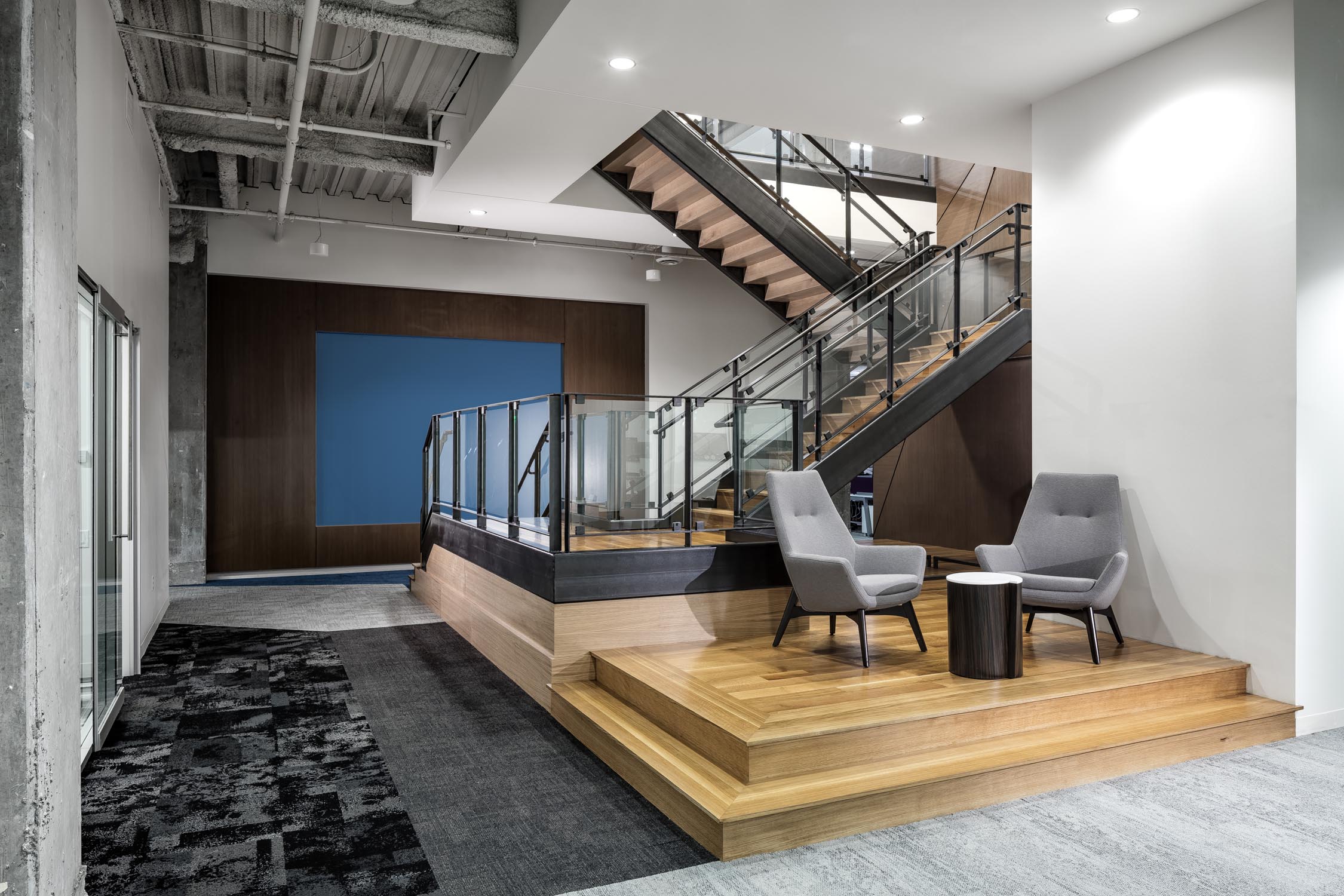
    Maybe it’s time we all re-examined the potential of below grade spaces.  As OTJ and Gensler proved, they can be assets rather than liabilities with a little good design and capital investment.

  • Fish & Richardson’s Shared Services Hub: A Case Study on How to Successfully Consolidate Operations

    Fish & Richardson’s Shared Services Hub: A Case Study on How to Successfully Consolidate Operations

    Can a law firm with 14 offices around the United States and Europe consolidate all of its shared services operations to one location, and in the process save money and improve productivity?

    The answer is “yes” if you ask Fish & Richardson.

    The Situation

    About four years ago, Fish & Richardson’s Chief Operating Officer, Rick Anderson, started exploring the possibility of a shared services “hub.”  It was Anderson’s belief that having all of the firm’s shared services functions under one roof would not only reduce real estate costs, it would also improve operations through increased collaboration.

    Photography by FarmKid Studios

    Anderson thought he could bring finance and accounting, IT, HR, risk and compliance, conflicts, and marketing to Minneapolis – the firm’s headquarters.  He also thought he could consolidate the firm’s experts (PhDs and engineers) who work with attorneys across the firm into one location.

    The Perfect Solution

    Working with Mark Minich, Anderson’s real estate advisor at CBRE, Anderson identified a great option in the firm’s existing headquarters building.  The building’s ownership was interested in converting the third and fourth floors of the building from retail to office space.  The ownership also wanted to extend Fish’s office occupancy as long as they could and realized that by bringing in additional functions, Fish was more likely to extend its term.  Consequently, Minich was able to negotiate a very competitive rental rate (less than half the rent asked on the higher office floors) and tenant improvement package on the third and fourth floors.

    I cannot overstate the brilliance of using converted retail space from both the Landlord’s and Fish & Richardson’s perspective.   Often law firms try to save money by putting their non-revenue generating employees in less expensive space.  This can sometimes result in basement locations with zero natural light or locations geographically remote from the rest of the firm.  While this can and is working for some firms, I believe it’s ideal to identify space that isn’t working for the landlord but is still desirable (as is often the case with retail space in this era) and re-purpose it for the benefit of landlord and tenant.

    The floor plates of these floors are a generous 30,000 square feet and boast exceptionally high ceilings.  The building is a “wedding cake” design where the floors get progressively smaller as you go up in the building.  As such, the floors above each Fish floor were slightly smaller, so Nelson added skylights to maximize daylight in the space.

    Photography by FarmKid Studios

    The Layout

    Fish & Richardson engaged Scott Hierlinger with Nelson architects to design space that would be attractive to the employees and conducive to greater productivity.  Nelson’s design began with a very open floor plan with low profile workstations and few private offices.  Nelson then added 90 private workspaces (everything from phone booths to treadmill desks) where employees could go for focus time or small group collaboration.

    Photography by FarmKid Studios

    Designers incorporated demountable walls throughout the space to allow for flexibility to change the layout as the law firm’s business demanded.  White noise and ceiling clouds were utilized to reduce sound distraction.  A mezzanine was installed on one wall to add some visual interest.  And a beautiful open interior stairwell was added to encourage interaction between the two floors.

    Photography by FarmKid Studios

    The Furnishings

    The conference and huddle areas vary greatly to accommodate different work style preferences.  There are rooms with soft seating and walls on only three sides as well as rooms with traditional conference tables, wall-mounted monitors and doors you can close.  There are rooms with side-by-side treadmill desks or high top tables or even lounge chairs.  All of these options get plenty of use according to Anderson.

    Photography by FarmKid Studios

    How did Anderson and Fish implement this consolidation?

    The change management began one year before the consolidation took place when Fish announced the plan and offered all affected employees relocation opportunities.  While many did not opt to relocate to Minneapolis, the net result of this advance notice was increased employee loyalty (even among those not relocating) and a willingness to help the firm train replacements and effectuate the plan.

    Senior managers in each department were consulted throughout the design process and their feedback was incorporated in the final plan.

    Did It Work?

    Absolutely, but as Anderson says “the employees weren’t all sitting in a circle singing Kumbaya on the first day.”  It took some time for all of the employees to adjust to the new geography, location and floor plan. But now, staff retention has improved.  Firm metrics tracked by departments working in the space (such as days revenue outstanding) have improved.  And the cost savings is significant as the square feet per employee is a lean (especially for law firms) 250 and the rental rate is below market.

    The Takeaways

    (1) Look at non-traditional office space but with an eye to making it inviting and collaborative, rather than boring “call center” type space.

    (2) Don’t be afraid to be honest with your employees about your plans.  They may appreciate and respect you for it, as Fish found to be the case.

    (3) Give your employees workspace choice and daylight within the space.  Hierlinger’s philosophy sums it up well: “make workspaces experienced daily more enjoyable.”  If you do this well, your employees with reward you for it with their loyalty and productivity.

    Good idea.  Good deal execution.  Good design.  Good implementation.

    Kudos, Fish & Richardson and team!